


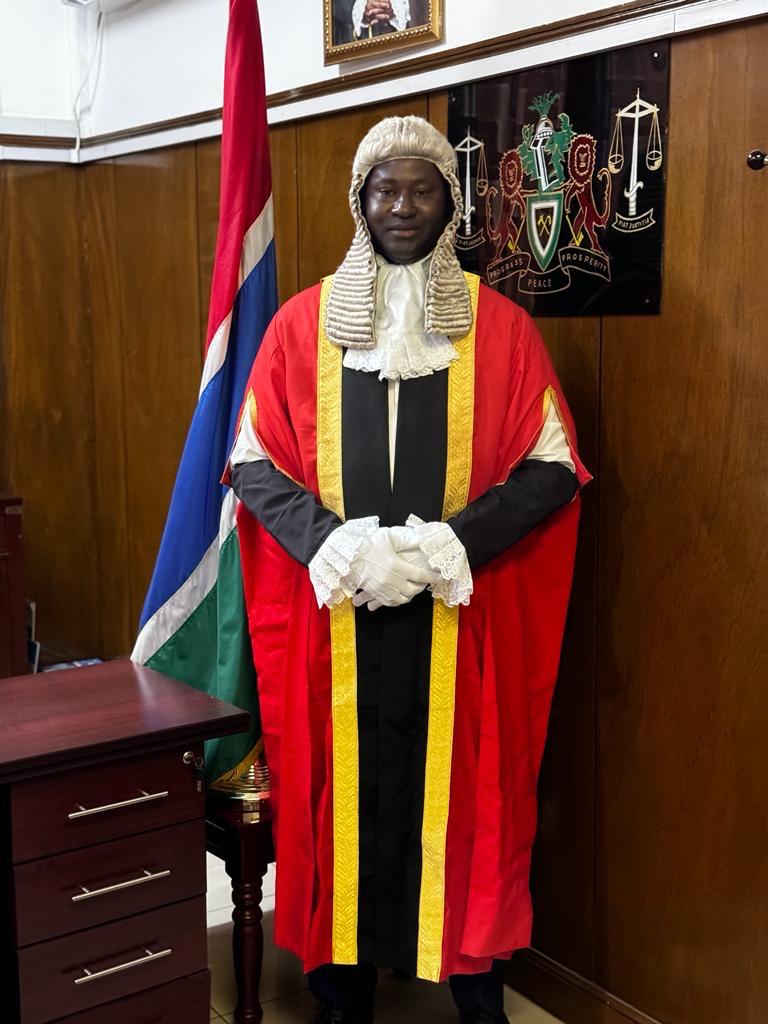
The High Court on Wednesday heard testimony from Dr. Mustapha Bittaye, Chief Medical Director of the Edward Francis Small Teaching Hospital, in a lawsuit arising from the 2022 acute kidney injury (AKI) outbreak that claimed the lives of dozens of children across The Gambia.
Appearing before Justice Jaiteh as the third defence witness, Dr. Bittaye described the government’s response to the crisis, which has been linked to four imported medicinal syrups: Promethazine Oral Solution, Kofexmalin Baby Cough Syrup, Makoff Baby Cough Syrup, and Magrip N Cold Syrup. The products were manufactured in India and imported by Atlantic Pharmaceutical Company, the second defendant in the case.
Dr. Bittaye, who served as Director of Health Services at the time of the outbreak, testified that his involvement began on July 27, 2022, after receiving an urgent call from a pediatric specialist reporting a “rising pattern” of AKI cases with an “unusually high fatality rate.”
He told the court that he immediately instructed the Epidemiology and Disease Control Unit to launch an investigation. The team, he said, initially encountered “access challenges” at the hospital. According to his testimony, the head of the paediatrics department had initially attributed the spike in cases to improved detection by a newly recruited specialist. Dr. Bittaye said his office subsequently issued formal letters authorizing full access to enable investigators to begin work the following day.
Dr. Bittaye testified that the outbreak coincided with severe flooding in parts of the country, including Tobacco Road, Bakoteh, and Basse. Given the conditions, he said, health officials—including the President and the Minister of Health—initially suspected a waterborne diarrheal disease caused by bacterial contamination.
To address that possibility, the ministry adopted what he described as a “two-pronged strategy,” testing wells nationwide while also examining potential viral and bacterial sources of infection.
As a precautionary measure, he said, the ministry issued a directive on September 7, 2022, suspending and quarantining paracetamol syrups pending laboratory analysis.
Early laboratory results from Senegal, Dr. Bittaye testified, did not initially detect diethylene glycol (DEG) or ethylene glycol (EG), substances known to cause kidney failure. Despite the preliminary findings, which identified only paracetamol, the ministry pursued additional toxicological testing by sending samples to other countries.
It was only after overseas analyses were completed, he said, that contaminants were confirmed in certain cough and promethazine syrups. Following that confirmation, a nationwide recall was conducted to remove the affected products from pharmacies and hospitals.
In his written statement, Dr. Bittaye said that the causes of death were not always definitively linked to the contaminated syrups. He noted that the World Health Organization had stated the deaths “may be associated” with the syrups, but described the connection as “not conclusive.”
He maintained that the Ministry of Health acted in “good faith” and in the public interest, relying on the best available information at the time. He cited subsequent reforms — including the establishment of a new national laboratory and a pharmacy school — as evidence of efforts to strengthen regulatory oversight.
The courtroom atmosphere shifted as Counsel L. Farage began cross-examination, pressing Dr. Bittaye on inconsistencies and gaps in his recollection. Below is the verbatim cross-examination of Counsel L. Farage.
Counsel Farage: Can you explain your duration of working with the hospital?
Dr. Bittaye: I have been in the medical field since 2006.
Counsel Farage: Did you have any outbreak of acute kidney injury?
Dr. Bittaye: I am not certain about the date of the outbreak. I cannot be specific on the number of AKI outbreaks in the hospital, but AKI occurs many times.
Counsel Farage: Was this outbreak reported?
Dr. Bittaye: I cannot tell whether the outbreak has been reported or not.
Counsel Farage: Provide proof of the cause to this court.
Dr. Bittaye: The number of children was not established. During the occurrence of AKI attacks, there was flooding in the country, which might be linked to it, from June to October 2022. We came to realise that the outbreak was connected to diarrhoea beyond the flooding, which contaminated the waters.
Counsel Farage: Flooding occurred in 2021, but nothing like AKI happened then. Can you tell the court the number of children who died due to AKI before?
Dr. Bittaye: I cannot tell whether there were cases or not. An expert called Professor Vivian detected that children’s acute conditions might be linked to paracetamol consumption. I was notified about the deaths around July 2022.
Counsel Farage: Can you tell the court the number of dead around September?
Dr. Bittaye: I cannot remember it off-hand.
Counsel Farage: Where was the laboratory test conducted?
Dr Bittaye: It was conducted in the Gambia, but the analysis was done in Senegal and Ghana. Drug samples were sent to Senegal and Ghana.
Counsel Farage: You were aware of which drugs were contaminated but refused to reveal the names of all the drugs.
Dr. Bittaye: I have no knowledge about it.
Counsel Farage: Around September, the Ministry of Health already knew who the culprits were in this case.
Dr. Bittaye: I was not aware of it until the President made a statement about it. I cannot answer for the MCA (Medicines Control Agency).
Counsel Farage: Are you aware that Atlantic Pharmaceutical Company was named in the report from the MCA?
Dr. Bittaye: I was not aware of that fact. We engage in risk assessment, which could have legal implications for us, by calling names without any evidence.
Counsel Farage: What about the systemic issues within the MCA?
Dr. Bittaye: There are significant capability problems, human resource gaps, and equipment shortages affecting the health sector.
Counsel Farage: Was there a conflict of interest in drug registration?
Dr. Bittaye: Personal interest in conflict was affecting the MCA because some MCA staff members are part of the affected group. Most employees of the MCA own pharmacies.
Counsel Farage: Did this affect the agency’s oversight?
Dr Bittaye: We perceive that there was a conflict of interest in the MCA, and separation of powers was not ensured. We have now put laws in place to enhance this.
Counsel Farage: You are a witness being cross-examined on your own tendered document. It is abnormal for you to forget relevant periods linked to this case. Be better prepared for the next date.
Dr. Bittaye: I cannot say things I do not know. By October, we realised it was 27 dead, and by November, it reached 83 dead. Dr. Bittaye asserts that the Ministry acted on the best available information and that long-term reforms, including a new laboratory and a pharmacy school, are underway to prevent such a tragedy from recurring.
The case is adjourned to February 26, 2026, for the continuation of the cross-examination.
Comments are closed.