


By Seedy Jobe
The Public Utilities Regulatory Authority faced pointed questions from lawmakers on Monday over delays to its planned headquarters, after auditors reported that the agency had paid more than 46 million dalasis to a contractor despite what they described as minimal progress on the project.
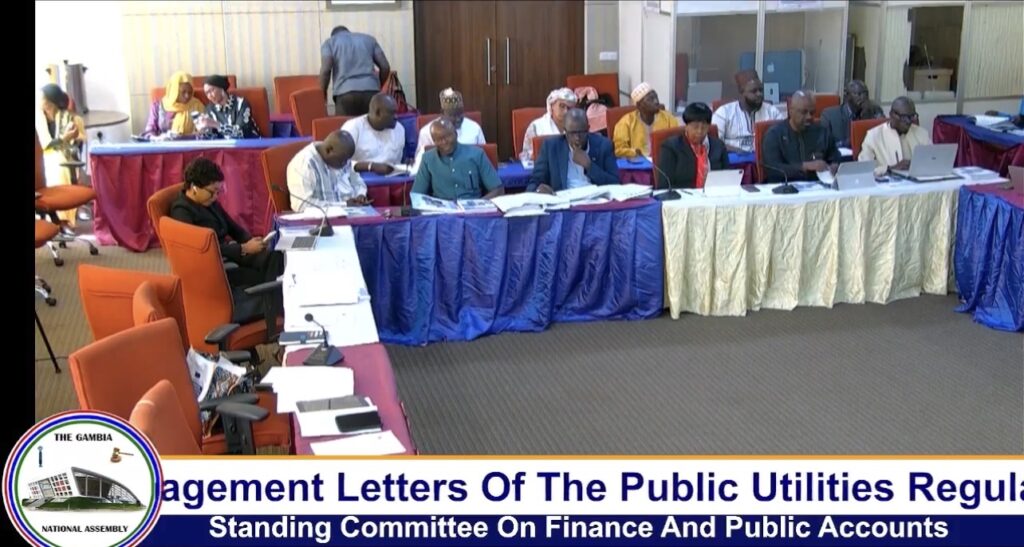
Appearing before the National Assembly’s Finance and Public Accounts Committee, officials from PURA presented their annual reports and financial statements as part of routine oversight hearings. But much of the discussion centered on the stalled head office building, originally scheduled for completion in October 2025 and now pushed back by a year.
In their management letter, auditors said they were concerned that the authority had paid 40 percent of the contract sum—equivalent to 46,346,581 dalasis—while visible progress on the site remained limited.
“We noted with concern that since the authority paid 40%, which is equivalent to D46,346,581 of the contract value to the contractor, only minimal progress was made,” the auditors wrote.
PURA’s management attributed the delays to a change in the project site from Kanifing to the Bertil Harding Highway, as well as additional soil testing and reinforcement works that were required before construction could proceed. The rainy season, they added, had further slowed activity.
“The 40% that was being protected by guarantee, which has been renewed in October 2025. The delay was caused by the change of site, from Kanifing to Bertil Harding Highway. And there was supposed to be also soil testing and reinforcement, and also the rainy season.” PURA responded.
They also noted that a supervising consultant had been contracted to monitor implementation on behalf of the authority and that the contractor was now working extended hours to recover lost time.
“There was a consultant that has been contracted to supervise and monitor the implementation of the project on behalf of Pura. And there is a new date for completion, and the work is in progress, and they are working day and night to ensure that they catch up with the time that has been lost.”
Pressed by the committee chair on the agreed completion date, management confirmed that the original target of October 2025 had been revised to October 2026.
The delay, officials acknowledged, will affect PURA’s long-anticipated move into a permanent headquarters. “The delay would impact our move to our new headquarters at the time that we anticipated,” a senior official told lawmakers.
The hearing also turned to the authority’s continued reliance on foreign laboratories to test fuel quality, a requirement under the Petroleum Products Act. In the absence of an accredited laboratory in The Gambia, PURA has contracted SJS in Senegal to conduct the tests.
“We have a contract with SJS Senegal; it’s better than not testing at all,” management said, explaining that the law requires fuel samples to be analyzed by an accredited facility — a capacity that does not yet exist domestically.
Auditors told the committee that the issue of fuel testing remains unresolved. Lawmakers questioned both the cost implications and the risk of regulatory gaps.
PURA officials said efforts to establish a national testing laboratory have so far been hampered by limited market scale, which has discouraged private investment. The authority has also approached the national standards bureau, but it lacks the capacity to provide accredited testing services.
However, management expressed optimism that the situation could change under the SIGPA project, a government initiative that includes plans to establish a national laboratory. An agreement has already been signed, officials said, and the laboratory is expected to serve broader national objectives beyond fuel testing.
Until then, PURA said it would continue to rely on its Senegalese partner, despite the added expense, arguing that external testing remains preferable to foregoing quality controls altogether.
Comments are closed.