

Supreme Court Hears Contentious Arguments in Case Challenging Ban on Female Circumcision

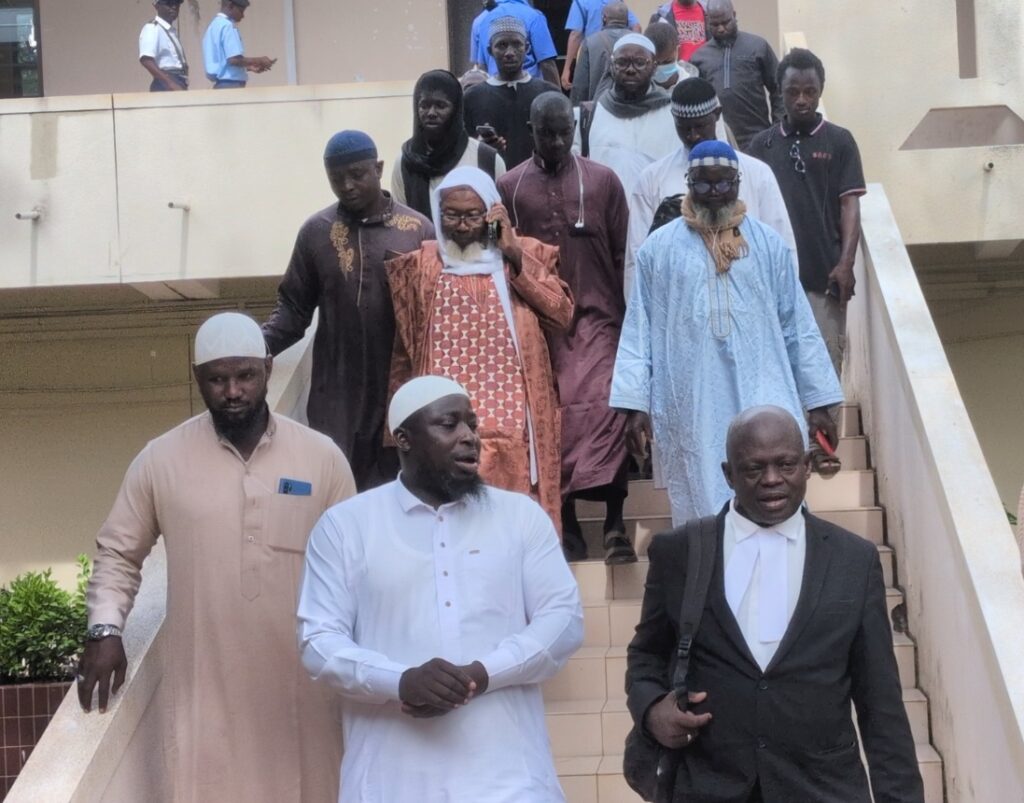
The Supreme Court of The Gambia on Thursday heard heated legal, religious, and cultural arguments as proceedings continued in the case seeking to overturn the ban on female circumcision.
State Counsel Okete opened the session, urging the Court to uphold the prohibition enacted through the Women’s (Amendment) Act. He argued that historic cultural practices cannot outweigh the State’s constitutional duty to protect the bodily integrity and fundamental rights of women and girls.
“The Constitution guarantees the rights of all,” Okete submitted. “Consent is not obtained before these procedures are carried out. The National Assembly acted to protect women and children, and its decision must be respected.” He urged the Court to rely on established jurisprudence and reaffirm the validity of the ban.
Following the State’s arguments, Counsel J. Darboe called Imam Abdoulie Fatty as the first witness for the plaintiffs, challenging the legality of the prohibition.
After being sworn in, Imam Fatty identified himself as a resident of Bakoteh and an imam and teacher. Under examination by Darboe, he testified that he appeared “for Islam and the Prophet regarding female circumcision.” He distinguished between what he termed “female circumcision” and what international organisations classify as Female Genital Mutilation (FGM), asserting that the more invasive form is not practiced in The Gambia.
Citing religious texts and scholarly opinions, Fatty argued that what he described as “Type 1” female circumcision is a Sunnah practice linked to cleanliness and modesty. He said the procedure, when performed correctly, is harmless and claimed that generations of Gambian women have undergone the practice without complications. He further argued that lawmakers failed to properly consult religious leaders before passing the Women’s (Amendment) Act, and urged the State to regulate rather than criminalise the practice.
During cross-examination, State Counsel Okete pressed Fatty on issues of safety, consent, legality, and medical risks. Fatty acknowledged he is not a medical doctor and relied primarily on religious doctrine, personal experience, and oral accounts. When questioned about reported deaths linked to the practice, he attributed mortality to divine destiny rather than procedural risk. He maintained that properly performed female circumcision does not violate human rights.
Counsel L. Farage, representing the Female Lawyers Association of The Gambia, interrogated the religious basis of the practice, the reliability of the Hadiths cited, and whether parental consent can justify procedures performed on minors. Fatty insisted that Type 1 circumcision is Islamic and that families should be free to choose. He dismissed international human rights and medical findings as exaggerated, repeating his call for “medicalization” rather than prohibition.
Counsel L. Mboge, representing the National Assembly, examined the scriptural and historical claims raised by the witness. Fatty maintained that the practice predates Islam but that the Prophet accepted and guided it. He argued that criminalization infringes on religious rights.
Throughout his testimony, Fatty rejected suggestions that supporting the practice encourages people to break the law. He said he was defending Islamic principles and asserted that religious obligation prevails over legislative bans.
After further objections and questioning, the Court discharged the witness and adjourned proceedings to Monday, when the second witness for the plaintiffs is expected to testify.
Below, we reproduce verbatim the examination and cross-examination of the witness
Counsel J. Darboe: Do you know why you are here?
Imam Fatty: Yes.
Counsel J. Darboe: What is that?
Imam Fatty: I am here for Islam and the Prophet, regarding female circumcision.
Counsel J. Darboe: Are you aware that female circumcision is banned in The Gambia by the National Assembly?
Imam Fatty: Yes.
Counsel J. Darboe: Can you tell the court your knowledge about female circumcision?
Imam Fatty: We are here for female circumcision, not FGM. If it were about FGM, we would not be here because that is haram (forbidden). That involves cutting the labia, and that does not happen in The Gambia.
He argued that, according to anti-circumcision advocates, only two deaths have been attributed to female circumcision since the practice began in the country.
He contended that believers are instructed to follow the teachings of the Prophet, and drew an analogy, saying that just as Type 1 diabetes cannot be treated like Type 2, they are following what he described as the “Type 1,” or Sunnah method. He challenged opponents to provide evidence of harm, asserting that the Prophet acted only by divine instruction.
He referenced various Hadiths which, he claimed, indicate that:
- During the Prophet’s time, women who had not undergone circumcision were instructed to have a minimal procedure performed;
- Female circumcision forms part of Islamic cleanliness requirements alongside cutting nails and trimming armpit hair;
- cleanliness is considered godliness;
- and that ritual bathing becomes obligatory if intimate contact occurs involving the part of the woman that is said to be circumcised.
He further stated that two women who embraced Islam were asked to undergo circumcision for purification.
When asked whether the Prophet’s wives or children underwent the practice, he initially described the question as offensive but proceeded to respond. He argued rhetorically that the Prophet’s community practiced circumcision, and questioned how Eve (“Na Awa”) could have raised children without knowledge of it.
He cited a narration in which the Prophet asked a female circumciser whether she still practiced her trade. When she confirmed she did, the Prophet allegedly advised her to cut only a small part. He further asserted that Islamic jurists consider female circumcision to be Sunnah, and referred to a text stating that female circumcision is Sunnah while male circumcision is obligatory.
He maintained that in Gambian society, all ethnic groups practice female circumcision, claiming that women have historically suffered no complications and have successfully given birth without medical intervention. He insisted that local experience shows no problems associated with the practice.
He urged Western actors to support national development instead of raising concerns about female circumcision, which he said is not harmful.
He concluded by arguing that Parliament amended the law without consulting religious leaders, despite religious authorities having declared the matter one of religious significance. He claimed the government only consulted a few individuals aligned with its position and misrepresented this as the stance of religious leaders.
Cross-Examination by Counsel Okete (for the State)
Counsel Okete: Imam Abdoulie Fatty, are you a medical doctor?
Imam Fatty: No, I am not a medical doctor.
Counsel Okete: Is it true that those who undergo female circumcision come to you?
Imam Fatty: I have four wives, and they gave birth to 16 girls, and they all underwent female circumcision.
Counsel Okete: You said two people died of female circumcision?
Imam Fatty: No, they (the activists) are the ones who said that; I was quoting them.
Counsel Okete: So, they died of female circumcision?
Imam Fatty: Yes, according to them.
Counsel Okete: What did you say to their families?
Imam Fatty: We are Muslims, and if someone dies, it is God’s destiny. People who go to battle die; people say if they hadn’t gone to battle, they wouldn’t have died, but God sent a message saying even if they were in their houses, they would die.
Counsel Okete: What are the traditional benefits of female circumcision?
Imam Fatty: In Islam, it is for cleanliness and to control the female desire for sex. Women are in the country while their husbands are abroad, and they keep themselves chaste.
Counsel Okete: Are you aware of the Constitutional provisions on this issue?
Imam Fatty: The law was brought by women and not Gambians. Let them ask the whole country.
Counsel Okete: Who is your representative in Parliament?
Imam Fatty: Hon. Madi Ceesay.
Counsel Okete: And he was among the people who passed the law?
Imam Fatty: No, it was the majority carrying the vote. But some members like Almami Gibba and the member for Kiang West stood against it.
Counsel Okete: But it was the decision of the members?
Imam Fatty: I know Madi and we spoke about it.
Cross-Examination by Counsel L. Farage (for the Female Lawyers Association)
Counsel L. Farage: Can you tell us anywhere in the Quran where female circumcision is mentioned?
Imam Fatty: In Surah Al-Asr, God advised to follow the Prophet’s advice and deeds.
Counsel L. Farage: Do you know that the Quran is the only word of God from Allah?
Imam Fatty: Yes, the Quran is Allah’s word.
Counsel L. Farage: And Hadiths are narrations from human beings. Is that correct?
Imam Fatty: Everything the Prophet said is from Allah; the Prophet does not speak from his own opinion.
Counsel L. Farage: Are you aware that Hadiths contradict each other on this issue?
Imam Fatty: No Hadith has prohibited female circumcision, but some are stronger than others.
Counsel L. Farage: So, your use of the word “stronger” means there are weak ones?
Imam Fatty: Yes.
Counsel L. Farage: The narration you mentioned comes from Abu Dawood?
Imam Fatty: Yes.
Counsel L. Farage: Abu Dawood said this Hadith is, in fact, weak because of the confusion of the narrator, Muhammad Hassan.Imam Fatty: The man is known throughout the world for his Hadith.
Counsel L. Farage: Islam is not only practiced in The Gambia. Do you agree with that?
Imam Fatty: Yes.
Counsel L. Farage: So, those who are not practicing it are still Muslims?
Imam Fatty: Yes, they found their people not doing it, but that shouldn’t mean that we who choose to do it should be banned. Since you talk about human rights, then our rights should be respected.
Counsel L. Farage: Those who are not practicing—have they diverted from Islam?
Imam Fatty: No one has ever said that.
Counsel L. Farage: You mentioned that the practice may have been performed the wrong way in The Gambia.
Imam Fatty: It is a profession; some can do it well, and some do not. That is why we are asking to teach it medically.
Counsel L. Farage: Did you visit the site of female circumcision?
Imam Fatty: Female circumcision is a secret, and men do not go there.
Counsel L. Farage: Who does it?
Imam Fatty: Every part of the country—from Mandinka, Jola, Fula, Serehule, Wolof all over the country. It is a choice.
Counsel L. Farage: You mentioned “choice,” whose choice?
Imam Fatty: The parents’.
Counsel L. Farage: Who trained the local female circumcisers?
Imam Fatty: This is why we said to medicalize it and not criminalize it.
Counsel L. Farage: Do you know what tools they use?
Imam Fatty: I cannot tell you that, but if you ask me about men’s circumcision tools, I could.
Counsel L. Farage: But you said two people died.
Imam Fatty: Yes, but my child died through an accident, and women died during operations including the child.
Counsel L. Farage: So, for you, the State shouldn’t intervene in circumstances where someone’s action causes the death of another?
Imam Fatty: Killing people takes three forms: intentional, unintentional, and something similar to intentional. The female circumciser never had an intention to kill any child. No person has died in Bakoteh, Brikama, or Basse all over the country, they only said two out of a two million population.
Counsel L. Farage: Are all the places you mentioned still practicing it?
Imam Fatty: God knows.
Counsel L. Farage: You told us that two people died.
Imam Fatty: That is what I heard.
Counsel L. Farage: So, you did not know it as a fact; you just heard it?
Imam Fatty: Hearing, feeling, and seeing are all forms of knowledge.
Counsel L. Farage: There could be a child who died that you didn’t know about.
Imam Fatty: I said if you know of one, tell us.
Counsel L. Farage: Do you know female circumcision is banned by law?
Imam Fatty: That is why we are here.
Counsel L. Farage: And you must follow the law.
Imam Fatty: Everywhere, it is the people who make a country. Any law that is coming into force must respect the culture and religion of the people.
Counsel L. Farage: Imam Abdoulie Fatty, you should follow the law until it is lifted. Do you agree?
Imam Fatty: Allah said this, and you said that, and you want me to follow you and leave God? When I die and meet God, I will be without you. I would rather die than follow you.
Counsel L. Farage: You are here to support Almami Gibba in lifting the ban, but unless it is lifted, it is the law.
Imam Fatty: There was no referendum; you didn’t consult anyone. The Islamic Council, the Islamic Enlightenment Society, and other religious leaders were consulted, but you didn’t take their positions.
Counsel L. Farage: Do you know that the National Assembly banned female circumcision?
Imam Fatty: How did it come about?
Counsel L. Farage: I know you were aware on the day the National Assembly banned female circumcision because you were there, and you said you support anyone who wants to practice it.
Imam Fatty: Yes.
Counsel L. Farage: So, you are supporting people to break the law?
Imam Fatty: No, I am not breaking the law; I am defending Islam.
Counsel L. Farage: You paid the fines for Yassin and Nano when they were convicted.
Imam Fatty: The women were put on a motorbike for seven kilometers during their arrest and taken to court. When it was confirmed, I went to defend their human rights.
Counsel L. Farage: So, the child that died didn’t have human rights
Imam Fatty: Female circumcision is not against human rights.
Counsel L. Farage: Those children who died—did they not have human rights?
Imam Fatty: What about the woman who dies in an operation? They have the right to live, but it is God’s destiny for them to die.
Counsel L. Farage: The child and woman didn’t have the right to live?
Imam Fatty: Who said that?
Counsel L. Farage: With regards to the Prophet, there is no evidence of any woman in his household who underwent female circumcision.
Imam Fatty: I tell you, let us not talk about the Prophet’s family regarding circumcision; that is an insult. Who would ask the Prophet’s wife, “Did you perform female circumcision?”
Counsel L. Farage: I’m asking whether you know or not if the Prophet’s wife underwent female circumcision.
Imam Fatty: I tell you, you cannot investigate the Prophet’s wives, but the Prophet’s wife advised someone in her house to take someone for female circumcision.
Counsel L. Farage: I am putting it to you that the Prophet did not teach anyone about circumcision.
Imam Fatty: He did.
Counsel L. Farage: You said the reasoning behind female circumcision is that it reduces a woman desire for sex.
Imam Fatty: The Prophet advises that a woman’s desire for a man has to be limited, because if the woman’s desire is stronger than the man’s, it is not good.
Counsel L. Farage: You said six women can have one man according to the population, and still, women remain. Where did you get that information?
Imam Fatty: Go to the statistics bureau, and you will find the information. The Prophet said at the end of the world, there will be one man to fifty women.
Counsel L. Farage: You said it has to do with cleanliness, but who teaches people how to cut their nails?
Imam Fatty: Some people cannot cut their own nails.
Counsel L. Farage: Imam Abdoulie Fatty, you just said that if a person didn’t die from female circumcision, it doesn’t mean they weren’t hurt.
Imam Fatty: I told you not all do it properly. Dr. Faal said when you cut, only a small drop of blood comes out, like when someone hurts a finger.
Counsel L. Farage: Are you aware that there is harm?
Imam Fatty: I said if it is done properly, it is not harmful. The people sitting here and my four wives are all good examples.
Counsel L. Farage: So, the State should surrender its responsibility to protect its citizens?
Imam Fatty: Then why not also ban male circumcision?
Counsel L. Farage: Do you agree that female circumcision is harmful?
Imam Fatty: What is harmful? Islam does not support harm.
Counsel L. Farage: Medical certificates and research prove that it harms.
Imam Fatty: It is not harmful.
Counsel L. Farage: While you are promoting FGM, are you aware of the medical reports on FGM?
Imam Fatty: We are talking about female circumcision, not FGM. Please show me one person one woman who died in labor because of female circumcision.
Counsel L. Farage: Have you read anything in connection with medical reports on the harmfulness of the practice?
Imam Fatty: People have rights regarding the Sunnah of the practice, and doctors like Faal confirmed the practice as harmless.
Counsel L. Farage: So, your answer is that you didn’t read anything about the reports?
Imam Fatty: I have read reports that support it and some that say it’s harmful.
Counsel L. Farage: Can you tell us which harmful reports you read?
Imam Fatty: All those from the side of the UN, GAMCOTRAP, and other organizations. Let them leave us in peace and allow those who wish to practice it to do so.
Counsel L. Farage: So, you have not read anything about the harm of FGM?
Imam Fatty: I am here for female circumcision. I don’t focus on those reports because I don’t believe them. The WHO in 1979 said there was no harm.
Counsel L. Farage: Are you aware that harmful practices are happening in The Gambia?
Imam Fatty: Why not educate them?
Counsel L. Farage: We will bring the women who were harmed before the court. You are only telling me about the people in court.
Imam Fatty: I am telling the whole country.
Counsel L. Farage: Do you not listen to the people who say it is harmful to them?
Imam Fatty: They are not telling the truth. They are married and have given birth. They do it for money.
Counsel L. Farage: Are you aware of the various types of female circumcision in The Gambia?
Imam Fatty: Type 1 and Type 2.
Counsel L. Farage: What is Type 1?
Imam Fatty: Type 1—if you practice it on a child, the next day she will be playing. Type 2—they remove the whole part. We are not in favor of Type 2; we have been educating people and encouraging Type 1.
Counsel L. Farage: That is what Islam is practicing?
Imam Fatty: If you people listen to us, you will be free because we are not people who will harm; Islam does not harm.
Counsel L. Farage: You mentioned that you have been teaching about female circumcision.
Imam Fatty: Yes.
Counsel L. Farage: And you also told us there are two types. How do you teach?
Imam Fatty: None of my children failed to undergo female circumcision.
Counsel L. Farage: I am asking if you have performed female circumcision.
Imam Fatty: You don’t know The Gambia, because males don’t get close to female circumcision.
Counsel L. Farage: Are you aware of females being “sealed” (infibulated)?
Imam Fatty: I didn’t tell you that, and I wasn’t referring to that.
Counsel L. Farage: But you mentioned Type 2.
Imam Fatty: Sometimes, the person who performs it doesn’t clean the blood, and the blood seals the person.
Counsel L. Farage: But that type is practiced here.
Imam Fatty: Who says we support that? That is why we said let’s medicalize it.
Cross-Examination by Counsel L. Mboge (for the National Assembly)
Counsel L. Mboge: I am a believer in the Prophet, and I am a Muslim. Can you tell the court whether female circumcision came before Islam?
Imam Fatty: Islam came first, and then tradition came later, but the Prophet’s time found the practice already there.
Counsel L. Mboge: Would you believe that the Prophet found it here?
Imam Fatty: Yes, and he agreed with it.
Counsel L. Mboge: Since Adam and Eve, how many Prophets have come?
Imam Fatty: 166,666. (I am not sure of the exact number).
Counsel L. Mboge: In your submission, you haven’t mentioned any other Prophet who endorsed the practice.
Imam Fatty: Ibrahim (Abraham).
Counsel L. Mboge: Why in your evidence-in-chief did you not say that it has happened since the time of Ibrahim and Adam?
Imam Fatty: I said Adam brought Islam into the world.
Counsel L. Mboge: You said there is a Hadith that says anything the Prophet advises or brings, we should follow.
Imam Fatty: It was God who said it; I didn’t say the Prophet said it.
Counsel L. Mboge: You told this court that the practice of female circumcision was happening before the coming of the Prophet. So, are you interpreting the practice from before or after his coming?
Imam Fatty: Anything the Prophet endorsed is accepted.
Counsel L. Mboge: You referred to a Hadith and its narration.
Imam Fatty: Yes.
Counsel L. Mboge: Can you tell how long female circumcision has been in existence?
Imam Fatty: When the Prophet came, it was known; before that, we referred to Ibrahim. But after the coming of the Prophet, anything he accepted or endorsed is Islam.
Counsel L. Mboge: You said there are two types, and the other one is not Islamic.
Imam Fatty: I have said Islamic circumcision is Type 1, and the rest are not accepted by Islam.
Counsel L. Mboge: Does it affect one’s life as a Muslim?
Imam Fatty: The Hadith says it is incumbent on all men and women, and if a woman does it, she will be rewarded.
Counsel L. Mboge: So, all schools of thought agree that if you don’t do it, it doesn’t affect your way of life as a Muslim?
Imam Fatty: No.
Counsel L. Mboge: Do you have any statistics from reports on female circumcision?
Imam Fatty: You people who conducted the study said it is 75%.
Counsel L. Mboge: No, it is 25%. Can you tell the court the percentage of tribes that perform the practice?
Imam Fatty: That is not my job.
Counsel L. Mboge: Regarding the reason you gave for female circumcision, you mentioned the desire of a woman.
Imam Fatty: Yes.
Counsel L. Mboge: Are you saying that if a woman is not circumcised, she will be “playful”?
Imam Fatty: It is both.
Counsel L. Mboge: So, it occurs with or without circumcision? It is a matter of desire and mindset.
Imam Fatty: The countries that do not practice it are the ones facing different illnesses.
Counsel L. Mboge: So, are you saying the law has to wait until someone dies?
Imam Fatty: The law found people already dying from other things.
Counsel L. Mboge: You are among the propagandists; why didn’t you take it upon yourself to teach the people instead of waiting for the State to educate them?
Imam Fatty: They are the ones who banned it.
Counsel L. Mboge: I am putting it to you that female circumcision is not Islamic.
Imam Fatty: It was endorsed by the Prophet.
Counsel L. Mboge: Do you know that the first, second, third, and fourth plaintiffs were the accused persons in the Kuntaur Magistrate Court, and they pleaded guilty?
Imam Fatty: We learned that they were fined and decided to go and pay the fine; we were not in court.
Counsel L. Mboge: I am further putting it to you that the case you present to the court is an extremist case and not a liberal one.
The court dismissed the question, and the witness was discharged. The case was adjourned to Monday for the testimony of the second witness.