


By Makutu Manneh
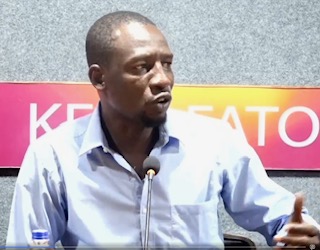
Kemeseng Sanneh, a member of the opposition People’s Democratic Organisation for Independence and Socialism (PDOIS), has sharply criticized President Adama Barrow’s administration over what he described as the mortgaging of state-owned enterprises, arguing that a government unable to manage its own resources lacks the moral authority to govern.
Mr. Sanneh, popularly known as Kexx, made the remarks during an appearance on Politic Kachaa, a weekly political and public affairs program broadcast on Kerr Fatou television.
He said that some of the country’s most strategic economic assets—including Gamtel, the Gambia Ports Authority, and the Senegambia Bridge—are now being managed by foreign entities, a development he framed as a public admission of failure by the state.
“We did not change a government in 2016 just to change a head of state, but also how to manage the economy of the country,” he said.
Mr. Sanneh acknowledged recent investments in infrastructure but questioned whether they had translated into tangible improvements in the lives of ordinary Gambians. He pointed to persistent shortages of medication in public hospitals and rising passport fees as evidence that economic development was not reaching most citizens.
He also raised concerns about transparency in the exploitation of natural resources, citing sand mining activities in Batokunku and Sanyang. According to Mr. Sanneh, the public has not been adequately informed about how much revenue those operations generate or how the proceeds are used.
“For me, development is not reflecting on the economy of the country. Sand mining is happening in Batokunku and Sanyang, but no one is telling the citizens how many resources are generated from that,” he stated.
Mr. Sanneh welcomed the ongoing electrification of rural communities but warned that the initiative could place additional financial strain on low-income households, particularly those unable to afford electricity meters or prepaid credit.
“People are thinking first about what to put in their stomachs,” Mr. Sanneh said, “and at the same time they do not want to live in darkness while other compounds have light.”
The government has previously defended its approach to public-private partnerships and foreign management of strategic assets, saying such arrangements are necessary to attract investment and improve efficiency. Mr. Sanneh’s remarks, however, reflect a broader debate in the country over sovereignty, accountability, and the direction of economic reform nearly a decade after the 2016 political transition.
Comments are closed.