

Judge Halts Ousainou Bojang Trial, Orders Fresh Transcription of Disputed Audio

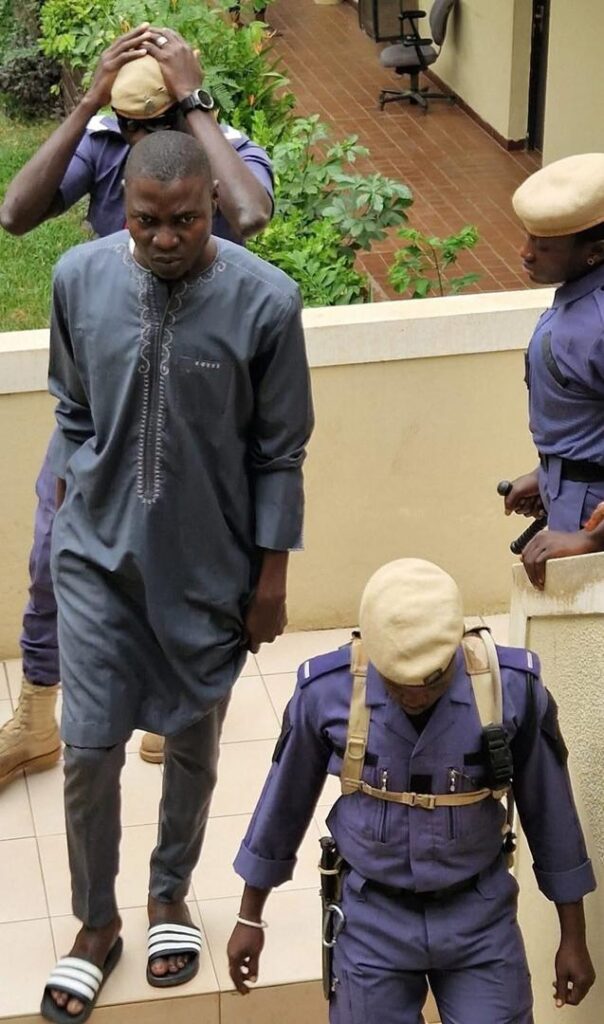
Proceedings in the murder trial of Ousainou Bojang and his sister, Amie Bojang, were abruptly halted on Tuesday after the presiding judge ordered a controversial audio transcription to be sent back for correction.
Justice Jaiteh’s decision followed a sharply contested exchange between prosecutors and defense lawyers over the accuracy of the transcript, which the State argued contained names that were never spoken in the recording.
The case, which has gripped public attention for months, drew a large turnout of young supporters from Brufut, who packed the courtroom as the matter resumed.
When the hearing opened, the Director of Public Prosecutions, joined by State Counsel F. Touray, appeared for the State. The defendants were represented by a team of lawyers, including J. Jeng, F. Bondi, and A. Sillah.
Moments after the counsels introduced themselves, the DPP raised a formal objection to the transcript submitted as evidence. He argued that the court transcriber had inserted the names “Mama Jabbi” and “Ousainou Bojang,” despite neither name being heard when the audio was played in open court.
Such additions, he said, amounted to “unwarranted assumptions” and introduced facts not supported by the evidence. Including names that did not appear in the recording, he warned, risked prejudicing the proceedings.
Defense lawyers pushed back forcefully. Counsel J. Jeng insisted that the audio did contain references to Ousainou Bojang, allegedly mentioned several times by the speaker identified as Mama Jabbi. Counsel A. Sillah added that the court had already been given context that the recording captured a conversation between Mama Jabbi and Ousainou, noting that the audio had circulated widely before the trial.
The transcriber, Sillah argued, had worked within that context.
Justice Jaiteh disagreed, underscoring the strict standards governing court records. Transcribers, he said, are required to reproduce recordings “verbatim” and are not permitted to infer identities or add details that do not appear in the audio.
“The transcriber shouldn’t assume,” he said in his ruling. “They should transcribe verbatim without indicating the names as they were never mentioned in the audio that Mama Jabbi or Ousainou Bojang was speaking.”
He then ordered the transcription returned for immediate correction, directing that a strictly verbatim version be produced.
The case was adjourned to December 2, 2025, at 10 a.m., when the court is expected to receive the revised transcript.