


By Fatou Sillah
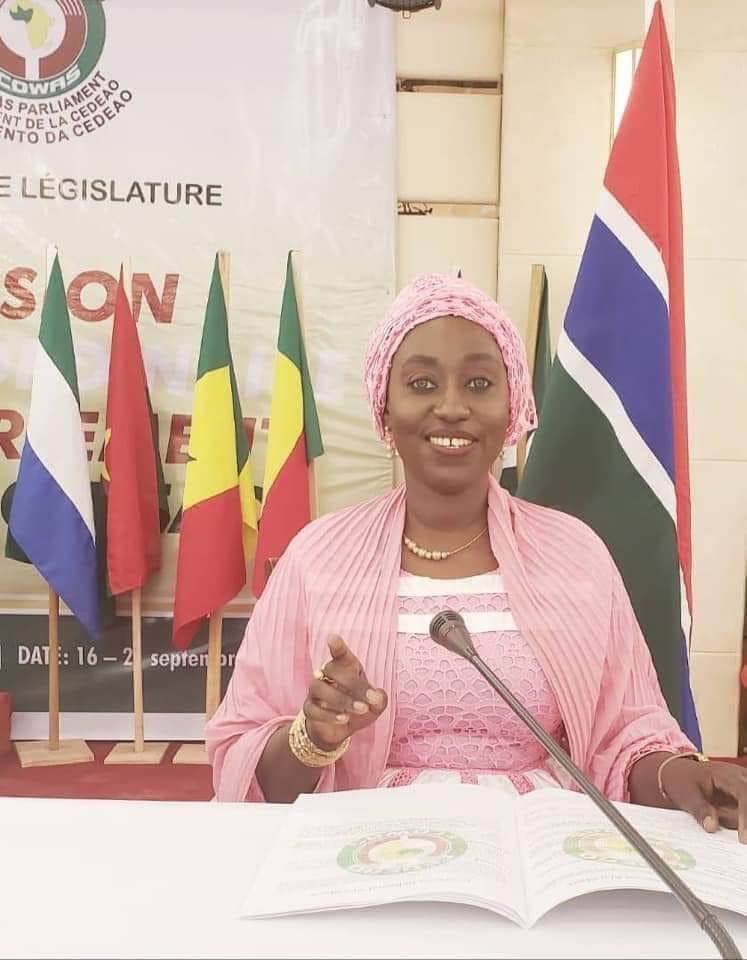
The National Assembly has announced that Hon. Fatoumatta Tuma Njai, Member for Banjul South and a member of the Gender Committee of the Pan-African Parliament (PAP), represented The Gambia at a high-level stakeholders’ meeting held in Dakar, Senegal, from October 20th to 23rd, 2025.
The forum, themed “Mobilising Stakeholders and Community Champions to End Child Marriage and Promote Girls’ Education in Africa,” brought together Pan-African Parliamentarians, traditional and religious leaders, and members of the Organization of African First Ladies for Development (OAFLAD) to strengthen their advocacy on these critical issues.
Hon. Njai was a key panelist in a discussion alongside representatives from Mauritania, Rwanda, Zambia, and Cape Verde. The session explored strategies to enhance collaboration among parliamentary education, gender, and youth caucuses in sustaining legislative engagement. A major focus was on the importance of parliamentary oversight in ensuring that governments deliver on their commitments to gender equality and girls’ education—turning policy promises into measurable outcomes.
In her remarks, Hon. Njai underscored The Gambia’s long-standing dedication to advancing education, tracing this commitment through successive administrations. She recalled the landmark 15-year education plan launched in 1988 under former President Sir Dawda Kairaba Jawara, which aimed to expand enrollment, lower the school entry age, and improve teacher training.
The statement further noted that Hon. Njai recognized the continuation of this vision under the Jammeh administration, which introduced free education for grades 1–6 and established the University of The Gambia.
She also commended the current government under President Adama Barrow for its substantial investment in higher education, highlighted by the inauguration of the state-of-the-art Faraba campus in March 2024.
The Dakar workshop was organized by OAFLAD, with support from the African Union International Centre for Girls and Women’s Education in Africa (AU CIEFFA), the World Bank Group, and UN Women.
Comments are closed, but trackbacks and pingbacks are open.