


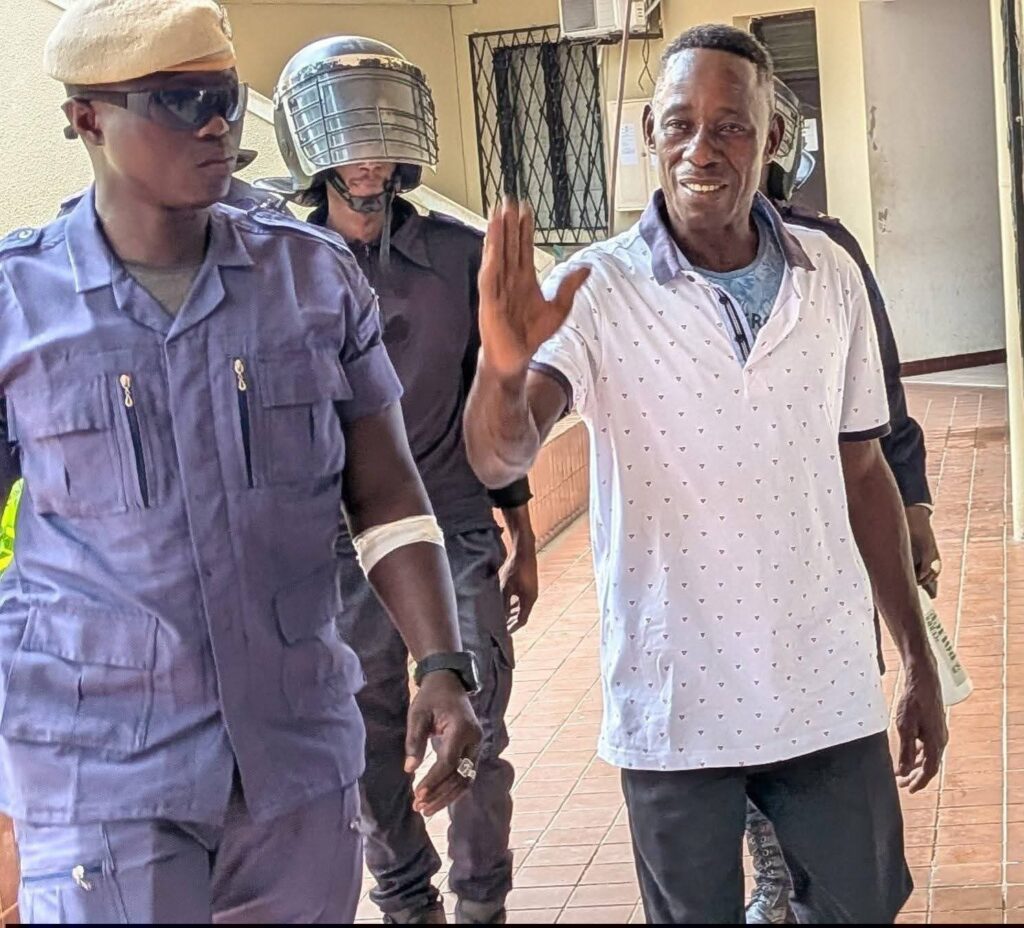
The High Court on Monday acquitted Abdoulie Sanyang, a Swiss-based Gambian national, of arson and interference with judicial proceedings, ending a prosecution rooted in a nearly decade-old fire and controversial public remarks about the country’s courts.
In a detailed ruling, Justice Ebrima Jaiteh said prosecutors had failed to meet the legal standard of proof beyond a reasonable doubt, underscoring that “suspicion, no matter how strong, cannot take the place of proof.”
Mr. Sanyang had been accused of financing the August 2016 burning of the APRC Bureau in Kanifing, an attack carried out by masked, armed assailants. While Justice Jaiteh accepted that the building was deliberately set ablaze, he found no evidence linking Mr. Sanyang to the crime.
The state’s case relied largely on a radio interview in which Mr. Sanyang was said to have acknowledged supporting the attack. However, under cross-examination, the investigating officers conceded that they had uncovered no financial records or documentary proof linking him to the incident.
The prosecution also called a police officer who was on duty the night of the fire. The officer testified that he could not identify any of the perpetrators. Mr. Sanyang, for his part, stated that his remarks had been misinterpreted and challenged the authenticity of the police cautionary statements attributed to him.
“The lingering doubt as to the accused’s participation is not speculative,” Justice Jaiteh wrote. “It arises from the absence of independent corroborative evidence required by law.”
He added that justice “is not a cloistered virtue,” signaling the court’s obligation to uphold due process even in politically charged cases.
The second charge stemmed from comments Mr. Sanyang made during a West Coast Radio interview, in which he described the judiciary as “clandestine” and “controlled.” Prosecutors argued that the remarks were capable of prejudicing the ongoing trial of Ousainou Bojang, amounting to interference with judicial proceedings.
Justice Jaiteh rejected that claim, noting that The Gambia operates a non-jury system in which professionally trained judges are expected to decide cases solely on the law and evidence, not public commentary.
He ruled that Mr. Sanyang’s statements fell within the bounds of fair criticism and were protected by the constitutional right to freedom of expression. The court found no evidence that any judicial officer had been intimidated or that any party in the Bojang trial had suffered disadvantage as a result of the broadcast. Nor, Justice Jaiteh said, had the state shown that Mr. Sanyang intended to obstruct the administration of justice.
Shortly after the verdict, State Counsel S. L. Jobarteh informed the court of the government’s intention to appeal and requested that Mr. Sanyang be remanded in custody, citing his residency in Switzerland.
Defense lawyer K. Jallow opposed the application, arguing that his client was now “a free man in law.”
Justice Jaiteh declined to order detention but exercised his discretion to grant bail for 50,000 dalasis, with one Gambian surety required to deposit a national identity card. He ruled that the bail would lapse after 30 days if the State failed to file a formal notice of appeal.
Comments are closed.