


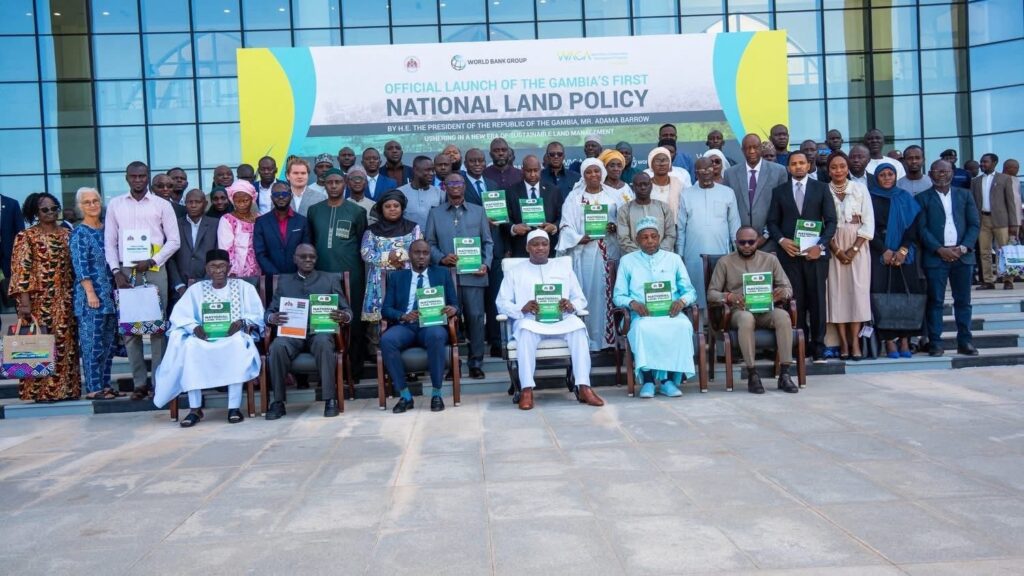
President Barrow and other dignitaries at the launch
By Makutu Manneh
The Gambia government on Monday launched its first unified National Land Policy, a far-reaching framework designed to improve land governance, promote sustainable development, and curb land-related disputes nationwide.
The policy, which will guide land administration from 2026 to 2035, was formally unveiled by President Adama Barrow at the Sir Dawda Kairaba Jawara International Conference Centre. It was developed under the Ministry of Lands, Regional Government, and Religious Affairs.
In remarks at the ceremony, President Barrow described the policy as a cornerstone of his administration’s reform agenda, aligned with pledges in his political platform and the National Development Plan, 2023–27.
He said the framework offers a “comprehensive and forward-looking” response to persistent and emerging challenges in land governance, with an emphasis on secure land tenure, legal certainty, and stronger administrative systems, particularly for vulnerable communities.
Calling the initiative a “major achievement,” Mr. Barrow said it strengthens legal frameworks, improves land administration, and formally recognizes the country’s diverse land tenure systems—a source of longstanding disputes and complexity.
“The National Land Policy 2026 to 2035 is a transformative tool for promoting land justice, strengthening national development, and safeguarding the environment,” he said. “Its effective implementation will enhance tenure security, encourage responsible investment, protect vulnerable populations, and align land governance with national and international standards for peace, prosperity, and sustainable development.”
Abdou B. Touray, the project’s local consultant, praised the inclusive and participatory process behind the policy, citing strong leadership and broad stakeholder cooperation. He described the document as “the people’s policy,” reflecting public aspirations for fair, efficient, and sustainable land use capable of driving economic growth and reducing poverty.
Masanneh Landing Ceesay, national project coordinator for the West Africa Coastal Areas Resilient Investment Project, called the launch “a historic day for The Gambia,” noting that while the project has supported several national policy initiatives, the land policy stands out in both scope and significance.
“This policy brings us together around a shared understanding of how land should be managed and used,” Mr. Ceesay said. “It provides a clear and fair framework to prevent land-related conflicts, protect rights, and ensure that land serves the collective interest of all Gambians.”