


By Seedy Jobe
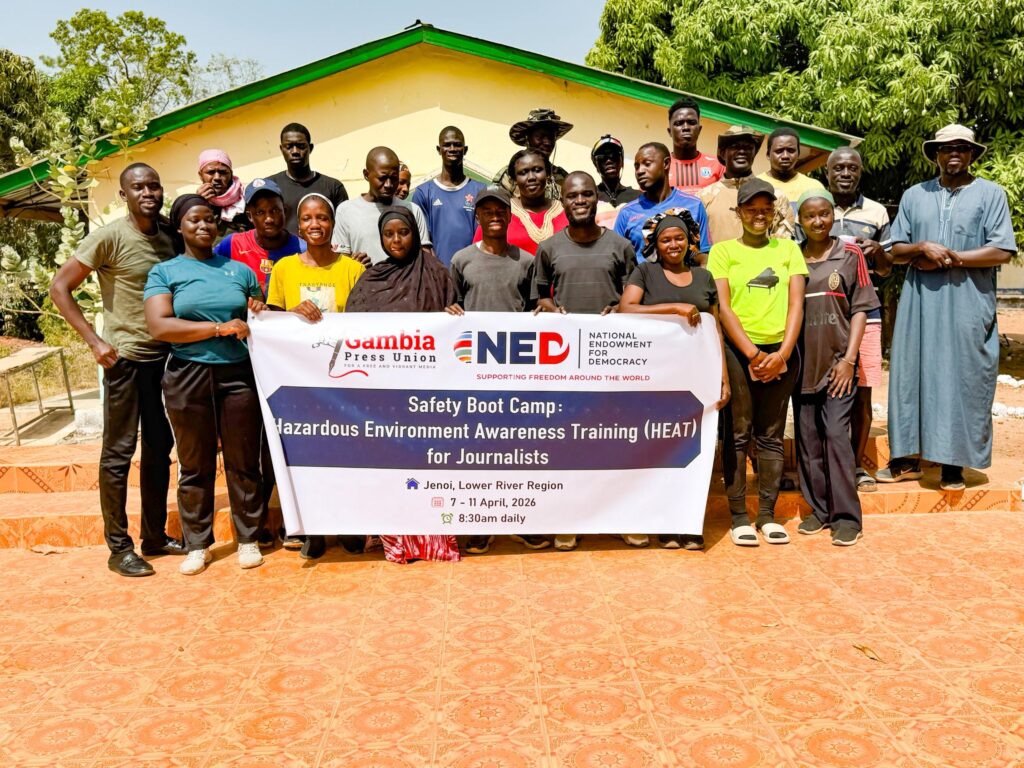
The Gambia Press Union on Saturday concluded a five-day safety training program for twenty-one journalists, as concerns grow about the risks reporters may face during the country’s upcoming electoral cycle.
The training, held from April 7 to 11 at the Rural Farmers’ Agriculture Training Centre in Jenoi, brought together reporters from print, broadcast, and online outlets for what organizers described as a Hazardous Environment Awareness Training, or HEAT. The program was supported by the National Endowment for Democracy.
Designed to prepare journalists for high-risk assignments, the course combined classroom instruction with simulation exercises and debriefing sessions. Participants were exposed to scenarios reflecting the kinds of conditions reporters may encounter while covering protests, civil unrest, and other volatile events.
Sessions focused on risk assessment, first aid, situational awareness, and both digital and physical security. Journalists also received guidance on operating in potentially dangerous environments, including areas affected by conflict or unrest, and took part in field exercises intended to test their responses under pressure.
Sang Mendy, managing director of the Media Academy for Journalism and Communication and the lead trainer, said the program was both resource-intensive and necessary, particularly in the lead-up to national elections.
“This kind of training is very expensive because you have to move about 20 people and camp them in a place where you can simulate hazardous environment activities, violent press conferences, protests, covering war, and places where journalists could be abducted,” he said.
He added that additional support from international partners would allow more journalists to benefit from similar programs in the months ahead.
“Organizing such training is expensive, and that’s why the GPU cannot bring in more than 20 journalists. If other international organizations have the possibility of supporting the Gambia Press Union to do more of this in the run-up to the electoral cycle, it will be really, really important,” he added.
Mr. Mendy said the timing of the training was critical. As The Gambia approaches an election period, he noted, public demonstrations and political gatherings are likely to increase, raising the possibility of confrontations that could put journalists at risk.
“When situations like that happen, sometimes those protests turn violent, and journalists are caught in the middle because they want to bring information to the people. In doing so, sometimes they don’t know what to do. So this training is very important, and those journalists who attended were equipped with the requisite skills, knowledge, understanding, and even the right attitude.”
The participants, drawn from a cross-section of the country’s media landscape, are part of a broader effort by the union to strengthen safety practices in newsrooms. The training, organizers said, is one of several initiatives aimed at improving both the preparedness and professionalism of journalists working in challenging conditions.
Comments are closed.