

Amie Bojang Alleges Prolonged Detention and Harsh Conditions as Trial Resumes

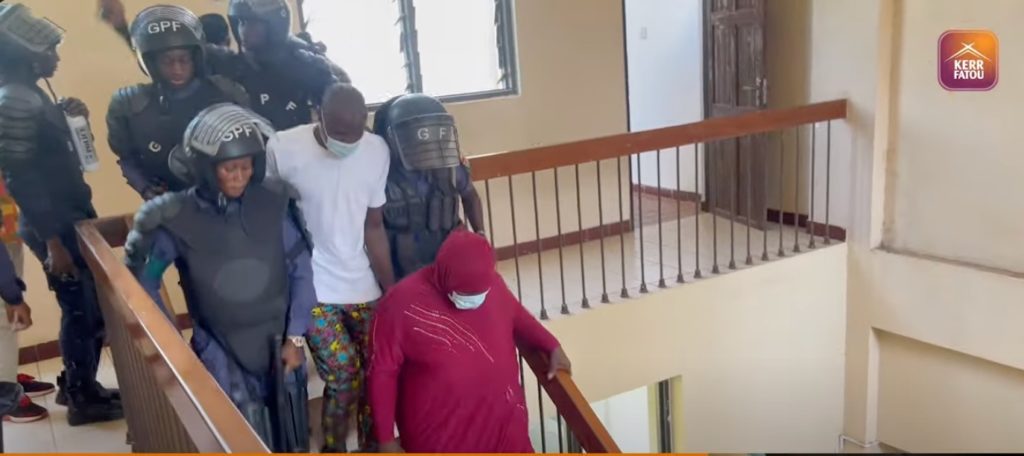
The trial of Ousainou Bojang and Amie Bojang resumed on Monday before Justice Jaiteh, with the second defendant, Amie Bojang, continuing her evidence-in-chief amid allegations of unlawful detention and mistreatment while in police custody.
When proceedings opened, the Director of Public Prosecutions, A.M. Yusuf, appeared for the state. Counsel J. Jeng represented the first defendant, while Counsel A. Sillah appeared for the second defendant.
Under examination by her lawyer, Ms. Sillah, Amie Bojang described the circumstances surrounding her arrest and subsequent detention, telling the court that she was held well beyond the constitutionally mandated 72-hour period before being brought before a court.
According to her testimony, she was initially taken to the Anti-Crime Unit’s charge office after her arrest and remained there until evening, before being transferred to Banjulinding Police Station, where she was detained for one week. She said she was then moved back to Anti-Crime and later returned to Banjulinding, where she spent an additional week.
“After the motorbike driver left the police station. I was taken to the charge office at Anti-Crime until the evening, and then I was taken from Anti-Crime to Banjulinding police station. I was there for one week. Then, after that week, I was taken back to Anti-Crime and later back to Banjulinding, where I stayed for another week.”
When asked directly whether she was detained beyond the 72-hour legal limit, Amie Bojang replied in the affirmative, stating that she spent more than a week in custody before being taken to the Kanifing Magistrates’ Court.
“So, are you telling the court you were detained beyond the 72-hour requirement?” Counsel A. Sillah asked
“Yes, I spent more than one week before being taken to Kanifing Court.” Amie Bojang replied.
She further testified that a statement was taken from her shortly after her arrest, and that approximately two weeks later, on a Saturday, an officer identified as Cham returned to take another statement. She told the court there was a two-week interval between the two statements.
Amie Bojang informed the court that she is illiterate and could only recognize her identification number on the statement. Presented with two documents—a cautionary statement and a voluntary statement—she identified one as hers and denied authorship of the other. She confirmed that she thumb-printed the statement she recognized.
Addressing the substance of the charge, she testified that the police informed her she was accused of assisting Ousainou Bojang to escape following the alleged murder of police officers, an allegation she firmly denied.
“I was told that I am charged for helping Ousainou to escape from the alleged murder, and I denied the allegation.” Amie Bojang testified.
She went on to recount her movements after her first court appearance, stating that she was again taken to the Anti-Crime Unit for one week before being transferred to Banjulinding Police Station, where she was informed that her lawyer wished to see her.
During that meeting, she said, she raised concerns about her detention conditions. “During my discussion with my lawyer, I told him he should ask them to keep me at Banjulinding instead of Anti-Crime because I was detained alone with boys in the same cell, and I didn’t have access to pray.”
According to her account, she was later returned to the Anti-Crime Unit for a further two weeks, during which time she became ill and was taken to the Yundum Barracks health center for treatment.
Amie Bojang also described an incident in which she was told she was being transferred to Mile 2 Prison. She said she was taken from her cell and placed in a vehicle, but noticed en route that the car was heading toward the airport. Upon questioning the officers, she said she was told they were “going for something.” At the airport, she testified, Ousainou Bojang was picked up.
“They told me they were going to take me to Mile 2. I was taken from my cell and entered the car. While going, I noticed we were heading toward the airport. I asked where we were going, and they replied that they were going for something. Upon arrival, Ousainou was picked up.”
“At the airport, one Gibba sat us down. I asked Ousainou Bojang what happened, but Ousainou said he didn’t have any idea why he was there because they were forcing him to accept that he killed the officers, but he refused.”
She told the court that at the airport, an officer identified as Gibba questioned Ousainou Bojang and urged him to confess to killing the officers and to say he had disposed of the weapon in a river—an account she said she rejected, telling the officer that Ousainou was young and a member of her family.
“One Gibba, he used to come to court here, told Ousainou to say he killed the officers but threw away the gun in the river. I refused and told Gibba that I am a family member and Ousainou is a young guy.”
Under further questioning by her counsel, Amie Bojang denied any suggestion that her brother had been involved with rebel groups or armed activities in Casamance. “No, Ousainou has never worked with a rebel group in Casamance. We are poor and survive with our sweat.” She told the court.
She also rejected claims that her brother was physically strong or militant, recalling an incident in which he fled upon seeing a police officer.”No, Ousainou is not a strong guy. I remember one time Ousainou saw an officer, and he ran for his life.”
Asked whether she had participated in an identification parade, Amie Bojang said she had never been subjected to one.
At this point, Amie Bojang concluded her evidence in Chief, and DPP A.M. was asked to cross-examine her, but he sought an adjournment. The presiding Judge Justice Jaiteh adjourned the case to tomorrow, 16th December 2025.