

Justice on Trial: Commissioner Sambujang Fatty Faces IGP in $5 Million Unlawful Termination Case

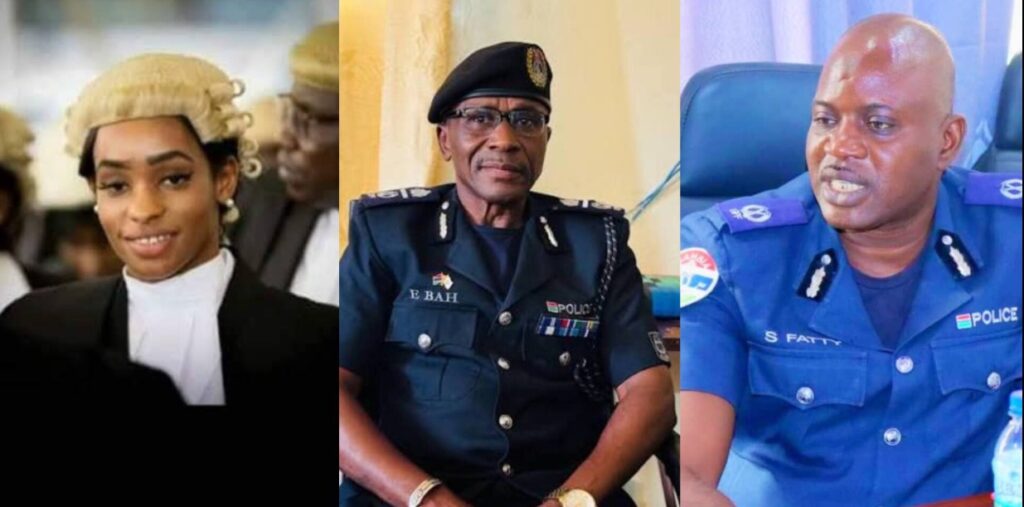
The courtroom became a focal point for accountability as the $5 million unlawful termination lawsuit between whistleblower Commissioner Sambujang Fatty and the Inspector General of Police (IGP) unfolded. At the heart of the proceedings are allegations of administrative irregularities, delayed reporting, and claims of exclusion from procedural hearings.
During a tense cross-examination, counsel K. Jallow questioned Assistant Inspector General (AIG) Ebrima Bah about discrepancies in the investigation of Commissioner Fatty. Key issues included why Fatty was excluded from his own hearing, why a 2024 report was only signed in 2026, and allegations of double-numbered pages and claims of tribal bias within the police hierarchy.
Presented below is a verbatim record of the cross-examination conducted by counsel K. Jallow with AIG Ebrima Bah.
Counsel K. Jallow: What is the role of the plaintiff (Sambujang Fatty) at the police as of October 2024?
AIG Ebrima Bah: He was the head of the planning and research unit.
Counsel K. Jallow: Is it correct that he was the commissioner responsible for planning, policy development, research, and training coordination?
AIG Ebrima Bah: Correct. As a commissioner responsible for planning, policy development, research, and training coordination.
Counsel K. Jallow: Is it correct, or are you aware, that he did prepare a document called the policy and planning development?
AIG Ebrima Bah: I am not aware of that.
Counsel K. Jallow: And because you are not aware, you will also not be aware if there was any reform and development that was made in respect of his office.
AIG Ebrima Bah: There was a lot of reform and development that was done well before he came to that office.
Counsel K. Jallow: As at the time he held that position, what was your role at the police or your position?
AIG Ebrima Bah: I was the head of the admin pillar.
Counsel K. Jallow: As the head of the admin pillar, do you know what is obtained in all other regions or the commissioner’s office?
AIG Ebrima Bah: As the head of the pillar, I have some units and departments under me, not the regions or elsewhere. There are certain units or departments that are under my pillar that I am supervising.
Counsel K. Jallow: As the commissioner responsible for planning and policy development, is that office under your command?
AIG Ebrima Bah: It is.
Counsel K. Jallow: When you say it is, does he take directives from you before he acts on anything? Are you his immediate boss?
AIG Ebrima Bah: Presumably, he should have, but he never did.
Counsel K. Jallow: When you say he never did, do you mean from the time he occupied the office or from October 2024?
AIG Ebrima Bah: Before he came to that office, somebody was there who was reporting directly to me, but when he assumed that office, he was reporting elsewhere.
Counsel K. Jallow: Okay. He was reporting elsewhere. Tell this court to whom he was reporting to.
AIG Ebrima Bah: He can better tell you. I wouldn’t know.
Counsel K. Jallow: You are the officer responsible for admin, and you believe that the commissioner was not reporting to you, and you continue to work with him, and you want this court to believe that you don’t know to whom he was acting from?
AIG Ebrima Bah: Perhaps he was reporting to the IGP or the DIG.
Counsel K. Jallow: And because you do not know to whom he was reporting to, you will not be in a position to tell this court if he was reporting to anyone.
AIG Ebrima Bah: I don’t know where he was reporting to.
Counsel K. Jallow: As the person responsible for admin, when an officer is not reporting to you, do you have powers under your TOR to do or deal with such an officer?
AIG Ebrima Bah: Yes, I did. What I did was report the matter to the IGP and the DIG.
Counsel K. Jallow: When you say you reported the matter to the IGP and the DIG, who was the IGP at the time?
AIG Ebrima Bah: The current Minister of Interior.
Counsel K. Jallow: Mr. Bah, when you were served or when this case was brought to your attention, don’t you think you were required to bring all this information to the attention of whoever is filing your defence on your behalf?
AIG Ebrima Bah: I did.
Counsel K. Jallow: From that statement, did you mention any time that you reported the acts or omissions of the plaintiff to the current Minister of Interior, when he was acting as the IGP?
AIG Ebrima Bah: I did not mention it because it was not relevant to this matter.
Counsel K. Jallow: Mr. Bah, is it correct that you had problems with the plaintiff before?
AIG Ebrima Bah: I never had a problem with him.
Counsel K. Jallow: When you say you never had a problem with him, even at the time you allegedly said he wasn’t reporting to you, you didn’t have a problem with him, and you reported him to the IGP?
AIG Ebrima Bah: When you say a problem, it means I have a confrontation or whatever. I never had a confrontation. I never had a problem with him. So when you imply having a problem, I will ask what kind of problem you are referring to because I can’t remember having a problem with him.
Counsel K. Jallow: You never had any issue with Mr. Fatty?
AIG Ebrima Bah: I never had any personal issue with him.
Counsel K. Jallow: Do you have any work-related issues with him?
AIG Ebrima Bah: No work-related issue.
Counsel K. Jallow: So it’s therefore correct that even if you said that he wasn’t reporting to you and you do not know he was reporting to you, it still was not a problem to you?
AIG Ebrima Bah: It was a problem. This is why I reported the matter to the IGP. But you cannot call that a problem that can create a kind of a friction or whatever between him and me. It wasn’t such a problem that could generate some tension between him and me.
Counsel K. Jallow: Mr. Bah, when was the first time you saw Exhibit B, that is, the petition?
AIG Ebrima Bah: July 2024.
Counsel K. Jallow: In July 2024. When you saw the petition, what did you do as the head of admin?
AIG Ebrima Bah: As I said, the petition came in as anonymous. When it came, there was no signatory on it. There was no name on it. So I reported the matter to the DIG who was on the scene at the time because the IGP was out of town. I did not say IGP, I said DIG.
Counsel K. Jallow: Take a look at the petition. Is the petition, is it a complaint against the acts or omissions of the DIG or a complaint against the acts or omissions of the IGP?
AIG Ebrima Bah: It’s against the IGP and his senior leadership, including the DIG.
Counsel K. Jallow: And because it includes the DIG, when you reported the matter to the DIG, did anything happen?
AIG Ebrima Bah: Yes, we asked the police. We suspected people who must have written it because it was anonymous… When it was reported to the DIG… then he decided to mention it to the SMT.
Counsel K. Jallow: Now, when you say Sambujang Fatty happens to be the primary suspect, what and how did you arrive at that conclusion?
AIG Ebrima Bah: We are police officers. We have informers. We have people around who can give us information whenever we need it.
Counsel K. Jallow: Do you [have investigation skills]? Yes or no?
AIG Ebrima Bah: I do.
Counsel K. Jallow: Is it based on those investigation skills that made you believe that the first suspect was Sambujang Fatty?
AIG Ebrima Bah: We have information within the police that he was the author. This is why he became a suspect.
Counsel K. Jallow: This information, was it in writing or oral?
AIG Ebrima Bah: It was both.
Counsel K. Jallow: Now tell this court, from your statement, when the said petition was anonymous, did you make mention of the person from whom the information originated?
AIG Ebrima Bah: We are not going to do that investigation. What we did was when we had information about the petition, and then we had a suspect, we decided to call him to find out and to confirm our suspicion.
Counsel K. Jallow: Mr. Bah, tell this court, at what point did you call the plaintiff about the petition? Was it before he…up himself or before he signed the petition?
AIG Ebrima Bah: It was before he signed the petition. When we got a suspicion that it was Sambujang Fatty who authored the petition, he was summoned to explain or to confirm whether it was actually him or not.
Counsel K. Jallow: Mr. Bah, you said Sambujang is answerable to you. Is that correct?
AIG Ebrima Bah: Yes, that’s correct.
Counsel K. Jallow: Do you know Commissioner Samba Jawo?
AIG Ebrima Bah: I do.
Counsel K. Jallow: What is his role or his position at the police as of 2024?
AIG Ebrima Bah: He was Commissioner for Admin.
Counsel K. Jallow: And as the Commissioner for Admin, is he the person to whom Sambujang reports?
AIG Ebrima Bah: Well, he can report to him, he can report to me.
Counsel K. Jallow: So, it’s correct that because he can report to you or report to Samba Jawo, you cannot tell whether he has been reporting to Samba Jawo. Can you?
AIG Ebrima Bah: I cannot tell whether he was reporting to Samba Jawo. That is between him and Samba Jawo.
Counsel K. Jallow: It is your evidence that you confronted him with it. Is that correct?
AIG Ebrima Bah: As the immediate supervisor, I was asked by the DIG to call him to SMT to confirm whether it was him or not. And I did that.
Counsel K. Jallow: So, when you say SMT, who were the panel or the members of that group?
AIG Ebrima Bah: When you talk of the SMT, it is the senior leadership of the police, in which the IGP is the chair, you have the DIG, you have all the AIGs, if the AIGs are not in place, they can delegate their commissioners.
Counsel K. Jallow: Mr. Bah, take a look at Exhibit B, the petition. When Exhibit A was written, was it addressed from Exhibit A? To whom is it addressed?
AIG Ebrima Bah: It was addressed to various institutions, the Office of the President, National Security Council, Permanent Secretary, Minister of Interior, Permanent Secretary, Public Service Ministry, and the IGP.
Counsel K. Jallow: And this petition at the police, when it arrived, and it was addressed to all these institutions, your investigation was limited to the police. Is that correct?
AIG Ebrima Bah: No. My lady, if you can allow me to explain, he was summoned to the SMT, and he appeared. When he appeared, before we even started questioning him, one of the SMT members realised that he was fiddling with his two telephones. And the AIG asked him to leave his telephones outside, which he refused. The AIG then asked him to leave his office if he was disobeying his lawful orders.
Counsel K. Jallow: That group you mentioned about, does it constitute only the police?
AIG Ebrima Bah: They are only police officers.
Counsel K. Jallow: Was the said Malang Jaju part of that group?
AIG Ebrima Bah: Malang Jaju was there.
Counsel K. Jallow: Good. This said Malang Jaju and the said Samujang, who is superior when it comes to ranks?
AIG Ebrima Bah: At the time, Malang was superior.
Counsel K. Jallow: What position was Malang?
AIG Ebrima Bah: Malang was the deputy commissioner. Samujang Fatty was an assistant commissioner.
Counsel K. Jallow: Was Malang not the chief superintendent?
AIG Ebrima Bah: He was not the chief superintendent.
Counsel K. Jallow: Do you have any documents to prove that Malang was Sambujang’s senior at the time?
AIG Ebrima Bah: Of course. There are documents to prove that.
Counsel K. Jallow: When you made mention of Abdou Bojang, was he present in that meeting?
AIG Ebrima Bah: Abdou Bojang was present, but he was asked to go out at the time of calling Sambujang because he was a junior officer.
Counsel K. Jallow: Did you make mention in your statement that the said Abduboyang was asked to leave before you interjected?
AIG Ebrima Bah: It was not relevant to mention.
Counsel K. Jallow: What is the difference between the chief superintendent and the deputy commissioner?
AIG Ebrima Bah: The Chief Superintendent is a junior officer to the Deputy Commissioner.
Counsel K. Jallow: Modou Sowe, was he there?
AIG Ebrima Bah: Modou Sowe was the DIG at the time. I cannot remember if he was there.
Counsel K. Jallow: And the said petition is against the senior management of the Gambia police force. Is that correct?
AIG Ebrima Bah: It is.
Counsel K. Jallow: Now, in the Civil Servant’s Code of Conduct, is it wrong for an officer to write to necessary institutions to make a complaint or a grievance against his or her management?
AIG Ebrima Bah: It is not wrong to do that, but you have to do it according to the established channels of communication.
Counsel K. Jallow: Because the complaint is against the senior management of the police, is it wrong for such a complaint to be addressed to the senior officer of the police?
AIG Ebrima Bah: It is wrong to do that. As per the public service rules… any complaint against your authority should be channelled to your head of department. And the head of the department of the police is the IGP.
Counsel K. Jallow: Since you made mention of it, do you know what is contained in paragraph 4.3.4?
AIG Ebrima Bah: I can’t remember.
Counsel K. Jallow: Mr. Bah, is Sambujang Fatty not a civil servant?
AIG Ebrima Bah: I think he is.
Counsel K. Jallow: Are you saying that the civil servant code of conduct is not fully applicable to the police?
AIG Ebrima Bah: It is, but we also have our own court of conduct in the police. Laws or frameworks that apply to other civil servants may not apply to police officers, because of the regimentation that we have.
Counsel K. Jallow: Because you do not know [which code is superior], you wouldn’t be in a position to say a complaint against the highest leadership of the police should be directed to the IGP.
AIG Ebrima Bah: I didn’t say that; it’s the Public Servant Rules. It is against those rules for a junior officer to report to a higher authority without going to the head of the department.
Counsel K. Jallow: This petition, was it investigated? Was the content of the petition investigated?
AIG Ebrima Bah: When he left the DIG’s office within one hour, he submitted a signed petition with his name on it. On the basis of the signed petition. The police wrote a rebuttal. Both the rebuttal and the petition were forwarded to the Office of the President, who directed the PMO to conduct an investigation… They recommended an in-depth investigation to the Public Service Commission. Therefore, a panel was constituted to investigate this allegation and the rebuttal against Sambujang Fatty.
Counsel K. Jallow: When you say an investigation was indeed conducted… are you saying that the content of the petition… was investigated, or you are saying that the conduct of Sambujang Fatty was investigated?
AIG Ebrima Bah: Both.
Counsel K. Jallow: Mr. Bah, take a look at Exhibit 1. What is the title of Exhibit 1?
AIG Ebrima Bah: Investigative report on the unethical conduct of DCP Sambujang Fatty
Stay tuned for continuance..
Comments are closed.