

By Seedy Jobe
The minister of agriculture, Demba Sabally, said in a recent television interview that he deliberately drew political attacks toward himself during the January Foni Bantanjang by-election as a tactic to shield his party’s candidate from scrutiny, while arguing that President Adama Barrow has fulfilled his obligations to voters and is poised for re-election later this year.
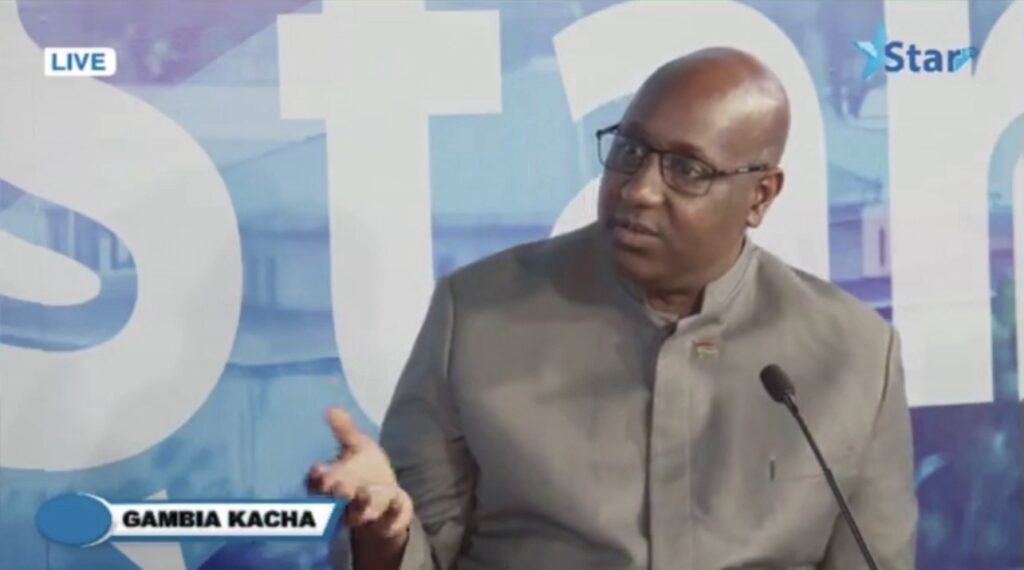
Speaking on Star TV’s Gambia Kacha program, Mr. Sabally said his approach was aimed at diverting the opposition APRC No-To-Alliance from focusing on the ruling National People’s Party candidate.
“They would have attacked and discredited my candidate,” he said. “So it was a strategy for me to get them to focus on me, insult me, and fight with me, allowing my candidate to stand clear and for people to have confidence in the candidate.”
Mr. Sabally rejected claims circulating on social media that he had released WhatsApp audio messages related to the campaign.
“I want to make one thing clear: nobody will say they heard an audio from Dr. Sabally,” he said. “I don’t release audios. All my speech is delivered from a political platform, and from that political platform, I am done.”
He dismissed criticism from opponents as personal and unfounded, saying he chose not to respond publicly because he was not the candidate on the ballot.
“As for me, I am focused, so I did not want to be distracted. They were personal attacks, and they were all false. So, if I were to say I want to waste time trying to defend myself as a person, I am not the candidate. The most important thing is the one who is to be voted for. So, for me, it was a strategy to distract them. They would have attacked and discredited my candidate. Therefore, it was a strategy for me to get them to focus on me, insult me, and fight with me, allowing my candidate to stand clear and for people to have credibility in the candidate,” he emphasized.
Beyond the by-election, Mr. Sabally used the interview to highlight what he described as the Barrow administration’s record in infrastructure, health care, and agriculture. He said the government had completed or nearly completed more than 2,000 kilometers of roads during President Barrow’s tenure and pointed to new hospitals and health facilities, including upgrades at the Edward Francis Small Teaching Hospital and the construction of facilities in Farato and other communities.
“As we speak, we have almost completed over 2,000 kilometers of roads under Barrow’s government alone,” he said. “Anyone in The Gambia can see the hospitals that have been built, from EFSTH to Farato, to all these new health posts that Honorable Samateh and his team have developed.”
On agriculture, Mr. Sabally said the government had disbursed about 2 billion dalasis to support the purchase of farmers’ groundnuts and introduced automated systems for crop marketing and fertilizer distribution.
“The Barrow government disbursed D2 billion to support farmers for their groundnuts to be purchased; in fact, everything is automated. Fertilizer is the same. So if these opposition people came, what would they do? There’s nothing they will do that can come close to Barrow,” he said.
Mr. Sabally expressed confidence that President Barrow would win the next presidential election, expected in December, while cautioning supporters against complacency.
“Barrow’s victory in 2026 is written,” he said. “We will not be complacent as the NPP, we will not be comfortable and sleep. We will continue the work that has gotten us here.”
He framed the anticipated outcome as a judgment by voters on the administration’s performance.
Comments are closed.