

“2,400 Hectares Cannot Feed 2.4 Million People,” Agriculture Minister Says, Defending Government’s Agricultural Programs

By Seedy Jobe
The Minister of Agriculture, Hon. Demba Sabally, has defended the government’s recent agricultural interventions, including the distribution of tractors and renewed efforts to boost rice production, amid criticisms that these initiatives are politically motivated.
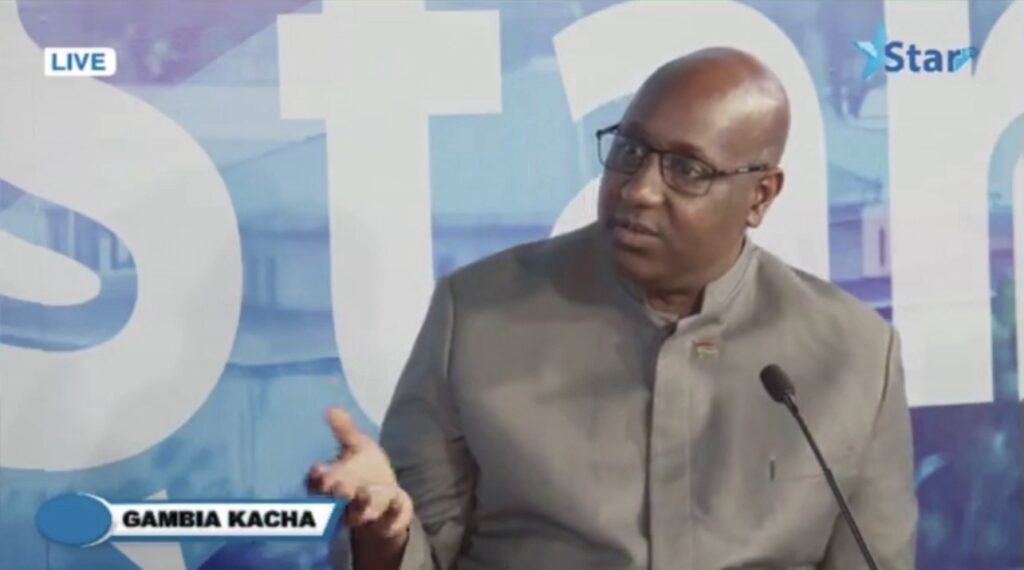
Speaking on Start TV’s Gambia Kacha program on Monday, February 2, 2026, Hon. Sabally said the government’s priority remains the welfare and food security of Gambians.
Highlighting one of the key initiatives, he stated, “The Barrow government, a few months ago, distributed 60 tractors to farmers, and the distribution was made at the State House in a scheme that is unprecedented in this country. President Barrow’s government introduced that, and 60 farmers profited from it.”
He noted that most Gambian farmers are smallholders. “80% of our farmers are considered smallholder farmers; if you are a farmer and your harvest area is less than a hectare, giving you a tractor wouldn’t benefit you because that’s only 10 minutes of a tractor’s work.”
For these farmers, he suggested, a donkey remains a more manageable and appropriate tool due to their specific capacities. However, he emphasized that tractor distribution still aims to ensure that “if your capacity is more than one hectare, you can access the service even if you don’t own a tractor yourself.”
On national food security, Hon. Sabally acknowledged the limitations of large-scale rice farms such as Jahally and Pacharr. “If you combine Jahally and Pacharr together, it’s 2,400 hectares. 2,400 hectares cannot feed 2.4 million people,” he said.
He emphasized the need for a nationwide approach to rice production to meet The Gambia’s annual demand of approximately 300,000 tons.
“Our work and our current vision are focused on upland farming. We aim to support farmers in every corner of the country, wherever a farmer is determined for rice cultivation, whether in lowland or upland areas. This is because 2,400 hectares, even with maximum productivity of 10 tons per hectare, would only yield about 240,000 tons, which is below the capacity The Gambia needs,” he said. “The Gambia needs about 300,000 tons of rice production. If we can produce and mill that as a country, that’s what can feed The Gambia. So we recognize that 2,400 hectares of Jahally Pacharr, no matter how productive we make it, will support the government’s food basket, but to supply the whole country, we must provide support in Jurunku, Sitanunku, Bondali, Sutukoba, and Dampha Kunda; it has to be spread out, and that’s our strategy”, Sabally said.
Responding to claims that these agricultural initiatives are politically motivated, he rejected the accusations. “Those saying this is an election strategy are deceiving themselves,” he said, adding that the government does not directly engage in rice sales.
“The government is not the one selling rice. 90% of people who order rice are traders and businessmen. They have very little to do with elections. Election or no election, they are businessmen, they will bring rice, they will be looking for profit, and they will be doing business in The Gambia.”
Hon. Sabally also highlighted the gradual increase in rice cultivation by private investors, citing examples of large-scale projects such as Hamidou Jah’s 2,000-hectare field in Bayaba, of which only a portion is currently in active production.
“The increase in rice cultivation is a gradual process. Today, if you look at it, in the last three years, powerful people have gotten into this. You have heard of Hamidou Jah, whose rice field in Bayaba has nearly 2,000 hectares at his disposal. But I think he has engaged with 200 hectares and so on,” he added.
Comments are closed.