


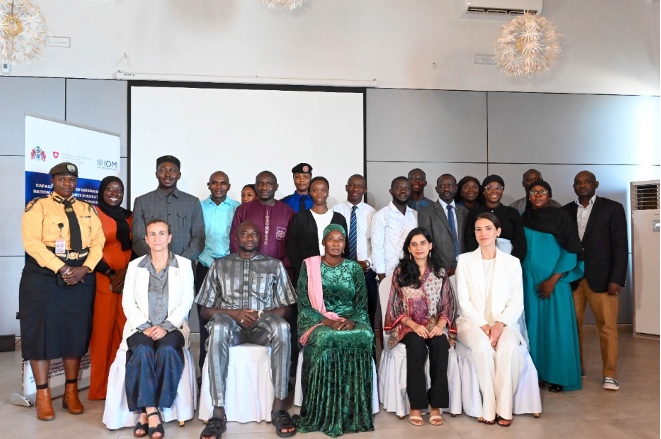
The International Organization for Migration (IOM), in partnership with the Ministry of Foreign Affairs, International Cooperation, and Gambians Abroad (MoFA), convened from 30 September to 2 October a three-day foundational training to strengthen The Gambia’s national response to migrant deaths and disappearances.
The training brought together 23 members of the National Task Force on Missing Migrants (NTFMM)—the national coordination mechanism established by MoFA with technical support from IOM—as well as Gambian diplomatic officials responsible for assisting Gambians in Spain, Italy, Greece, Malta, Morocco, and Mauritania.
Over three days, participants explored practical approaches to strengthen the knowledge, coordination, and institutional capacities needed to prevent migrant deaths and disappearances; search for and identify missing migrants; and manage cases and support families seeking information about their missing loved ones. The training also examined migration dynamics, vulnerabilities, and protection risks affecting Gambians along key migration routes, drawing on international experiences and good practices to inform comprehensive, route-based responses.
For the Government of The Gambia, strengthening this national response is both a matter of coordination and of ensuring that families are not left without answers.
“The Government of The Gambia recognizes that every missing migrant represents a human tragedy that extends beyond borders and deeply affects families and communities,” said Ndumbeh Saho, Director of Diaspora and Migration, MoFA. “This training marks an important milestone in our efforts to establish a coordinated and sustainable framework to address the issue of missing migrants and uphold the dignity and rights of those affected.”
Migrant deaths and disappearances remain a growing concern for The Gambia, particularly along the Western African Atlantic Route. According to IOM’s Missing Migrants Project (MMP), at least 408 Gambians have gone missing along migration routes since 2014, although the actual number is likely significantly higher due to persistent challenges in documenting incidents, particularly at sea. Recent tragedies off the coast of The Gambia, including the December 2025 Jinack maritime incident, which claimed more than 25 lives and left approximately 100 people missing, underscore the urgent need for strengthened prevention efforts, effective response mechanisms, and support for affected families.
“Behind every missing migrant is a family searching for answers, coping with uncertainty, and hoping for closure,” said Sibgha Ajaz, IOM The Gambia Officer-in-Charge. “Strengthening our ability to prevent deaths and disappearances, support affected families, and coordinate an effective response is, therefore, both a humanitarian responsibility and a collective commitment.”
The three-day exercise also supports the operationalization of the NTFMM, which is intended to coordinate national efforts to address migrant deaths and disappearances and strengthen the management of missing migrant cases. By clarifying roles and responsibilities across government institutions and strengthening national systems, the initiative aims to help ensure that cases are followed up more effectively and that families have greater access to information about the fate and whereabouts of their loved ones.
This work builds on The Gambia’s leadership in regional and international efforts to address missing migrants, including through its co-chairmanship of the Rabat Process Network of National Focal Points on Missing Migrants and its commitment to advancing coordinated responses to migrant protection challenges along migration routes.
The training was delivered as part of the project Capacity Building of Missing Migrant National Focal Points in Rabat Process Partner Countries (Mauritania and The Gambia), funded by the Swiss Federal Department of Foreign Affairs.
Comments are closed.