

Journalism Must Not Become Stenography for the Powerful, Madi Jobarteh Warns
By Seedy Jobe
Madi Jobarteh, executive director of the Edward Francis Small Centre for Rights and Justice (EFSCRJ), has warned that the digital space is becoming an increasingly dangerous battleground for electoral manipulation, urging Gambian journalists to strengthen their fact-checking and investigative reporting ahead of the December 5 presidential election.
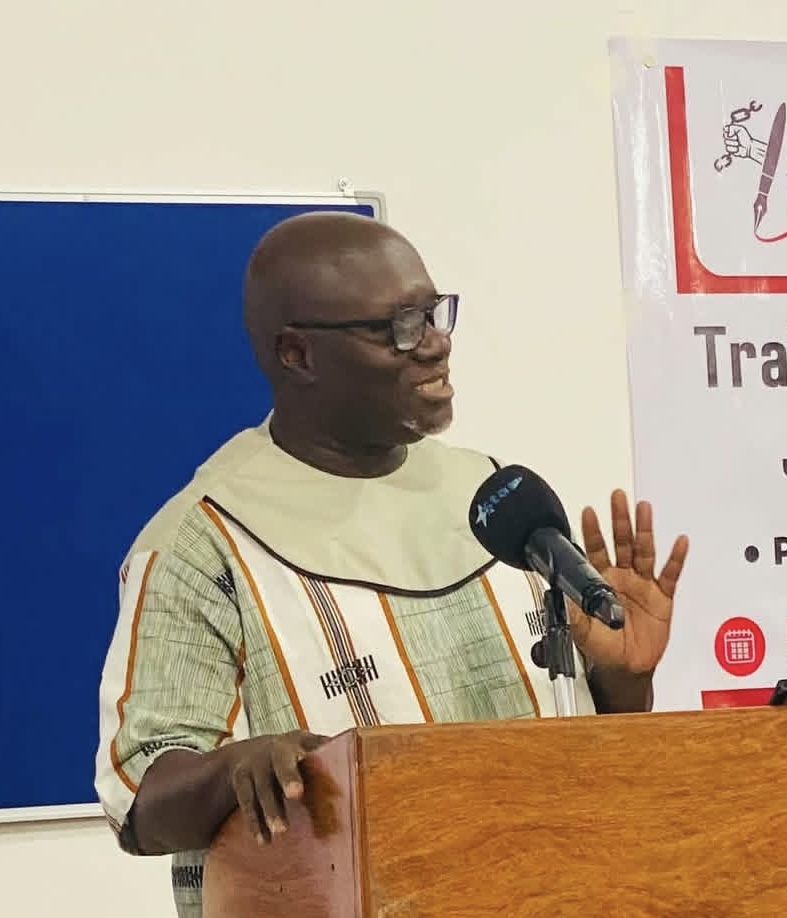
Speaking on Monday at the opening of a six-day training program on investigative journalism, election reporting, and fact-checking, Mr. Jobarteh cautioned that misinformation, disinformation, and malinformation pose serious threats to electoral integrity, public trust, and national stability.
The training, organized by the Gambia Press Union (GPU) and The Republic, with support from the National Endowment for Democracy, brings together 25 journalists to strengthen their reporting skills ahead of the elections.
Mr. Jobarteh said the rapid spread of false and misleading information through social media platforms and encrypted messaging applications had created new challenges for journalists, particularly during politically charged election periods.
He cited fabricated coalition agreements and manipulated images of political leaders as examples of deceptive content capable of influencing voter behavior, eroding confidence in democratic institutions and fueling political tensions.
Against that backdrop, he urged journalists to move beyond simply repeating politicians’ statements or reporting the circulation of controversial videos without establishing their authenticity.
He argued that responsible journalism requires rigorous verification, scrutiny of political claims, and deeper investigations into matters of public interest, including the sources of campaign financing.
Anything less, he warned, risks reducing journalism to stenography for those in power rather than holding them accountable.
Describing the training as a strategic intervention, Mr. Jobarteh outlined three critical areas designed to equip journalists with the skills needed to navigate an increasingly complex information environment.
The investigative journalism component, he explained, will focus on scrutinizing public procurement, tracking government expenditure, and following the flow of public funds. It will also address the safety of journalists investigating sensitive issues.
The election reporting component will examine the entire electoral process, from voter registration to post-election audits, emphasizing accuracy, ethical standards, and conflict-sensitive reporting.
Participants will also receive guidance on combating hate speech and ensuring inclusive election coverage, particularly for women, young people, and persons with disabilities.
Mr. Jobarteh urged journalists to devote greater attention to the everyday challenges confronting Gambians rather than allowing political spectacle and partisan exchanges to dominate election coverage.
He identified unemployment, rising food prices, unreliable water and electricity supplies, and inadequate healthcare as issues deserving sustained media scrutiny.
On fact-checking, Mr. Jobarteh described verification as one of journalism’s most effective defenses against disinformation.
He said the training would introduce participants to techniques for assessing the credibility of claims, authenticating photographs and videos, and using open-source intelligence tools to investigate questionable information without inadvertently amplifying falsehoods.
Warning that those who spread falsehoods often operate through organized and well-financed networks, he said journalists must be better equipped to identify and challenge attempts to manipulate public opinion.
Mr. Jobarteh also welcomed plans to develop a media handbook on audit reporting in collaboration with the National Audit Office, describing the initiative as an important step toward improving public understanding of government expenditure and strengthening accountability.
Reflecting on The Gambia’s history of press repression, he paid tribute to journalists who were silenced, imprisoned, forced into exile or killed for their work.
He said their sacrifices had helped create an opportunity for the current generation to practice journalism without the oppressive conditions that characterized the country’s former dictatorship.
Mr. Jobarteh urged journalists not to take those freedoms for granted, emphasizing that press freedom must be defended through independent, courageous and responsible reporting.
He reaffirmed his commitment to supporting journalists and encouraged them to resist intimidation, political pressure and attempts to silence critical reporting.
His remarks come as The Gambia approaches another presidential election, placing renewed attention on the media’s responsibility to provide voters with credible information, scrutinize political actors and safeguard public discourse against manipulation.
Comments are closed.