

Gambia’s Top Court Weighs Whether Former Auditor General Was Ousted or Resigned

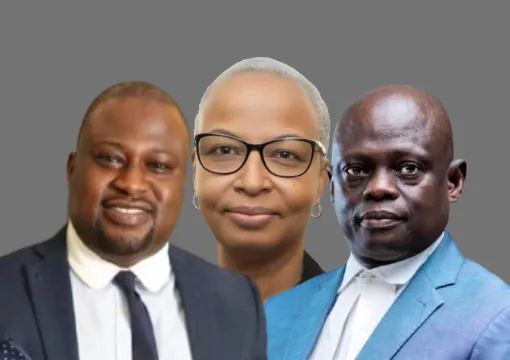
The Supreme Court of The Gambia heard final arguments this week in a case that could redefine the limits of executive power and the independence of public oversight institutions, as it considers whether former Auditor General Modou Ceesay was unlawfully removed from office or voluntarily relinquished his post after accepting a ministerial appointment.
The lawsuit, filed by Mr. Ceesay against the Ministry of Justice and the Inspector General of Police, centers on a starkly contested narrative: Was he “forcefully and unlawfully removed” from his constitutionally protected office, or did he cease to hold it by accepting an appointment to the Cabinet?
Appearing before a five-judge panel, Lamin J. Darboe, counsel for Mr. Ceesay, described the events as “a frontal assault on the rule of law,” arguing that the office of the Auditor General is deliberately insulated from executive control to safeguard national transparency.
Mr. Darboe told the court that the Constitution permits the removal of an Auditor General only under tightly defined circumstances—either physical or mental incapacity confirmed by a medical board, or misconduct or incompetence established by a tribunal chaired by a High Court judge and including other statutory members. No such process, he said, was initiated.
“There was neither a Medical Board nor a tribunal appointed,” Mr. Darboe argued, maintaining that his client was not removed on any lawful grounds.
Instead, he contended, the President sought to sideline Mr. Ceesay after he refused to halt or delay several sensitive audits, including those involving the National Food Security Processing and Marketing Company, land allocations at the Ministry of Lands, revenue matters at the Gambia Revenue Authority, and a 1.2 billion dalasi payment to the government. According to Mr. Darboe, his client declined to suspend the audits despite pressure from senior officials.
The State has argued that Mr. Ceesay accepted a ministerial appointment on Sept. 10, 2025, and thereby vacated his office. But Mr. Darboe said his client never accepted the appointment, either verbally or in writing. He pointed to what he characterized as irregularities in the appointment letter and noted that Mr. Ceesay formally declined the offer the following day.
When Mr. Ceesay refused to leave the National Audit Office, Mr. Darboe said, the executive turned to the police. He described his client’s removal as “barbaric,” asserting that the state itself acknowledged that police officers escorted him from the premises after declaring him a trespasser once a successor had been named.
To support his position, Mr. Darboe cited the Supreme Court’s decision in Ya Kumba Jaiteh v. Clerk of the National Assembly, arguing that the judiciary must resist implying executive powers that erode constitutional protections.
In response, Ida Drammeh, representing the Attorney General and the Inspector General of Police, dismissed the lawsuit as legally unsound and unsupported by evidence. She argued that the case pleaded by the plaintiff — that he was physically removed on presidential instructions — was not substantiated at trial.
Relying on established common law principles that parties are bound by their pleadings, Ms. Drammeh cited decisions, including Southport Corporation v. Esso Petroleum Co Ltd, to argue that Mr. Ceesay could not transform his claim into a broader constitutional challenge after failing to prove the specific allegation of forceful eviction.
“This is not a case of termination by the President at all,” she told the justices.
Ms. Drammeh maintained that the President lawfully appointed Mr. Ceesay as a minister under Section 71 of the Constitution, and that upon acceptance, he ceased to be Auditor General. She pointed to a State House announcement naming Cherno Amadou Sowe as his successor and argued that Mr. Ceesay’s continued occupation of the office after that date was unlawful.
Even by his own testimony, she said, he was asked to leave and did so — a sequence that does not amount to forcible removal in law.
Adding a broader perspective, Counsel A. Fatty, appearing as amicus curiae, urged the court to consider the institutional stakes. He argued that the office of the Auditor General is among the most heavily protected in the constitutional order, in some respects more insulated than that of a judge.
Mr. Fatty emphasized that the National Audit Office Act requires strict adherence to procedures, including a 30-day written notice in cases of resignation. Even if Mr. Ceesay had accepted the ministerial appointment, he argued, the statutory notice period would have precluded the near-immediate appointment of a successor.
“The office of the Auditor General needs protection,” Mr. Fatty told the court, urging the justices to reinforce democratic safeguards by insisting on strict compliance with constitutional and statutory requirements.
The Supreme Court has reserved judgment. Its decision is expected to clarify whether the episode represents an unconstitutional encroachment on an independent office — or a lawful transition from one public role to another — with implications that could reverberate across The Gambia’s system of public accountability.
Comments are closed.