

Bundung Maternity Hospital Doctor Testifies in Fatal FGM Case as Defence Challenges Evidence; Accused Collapses in Court

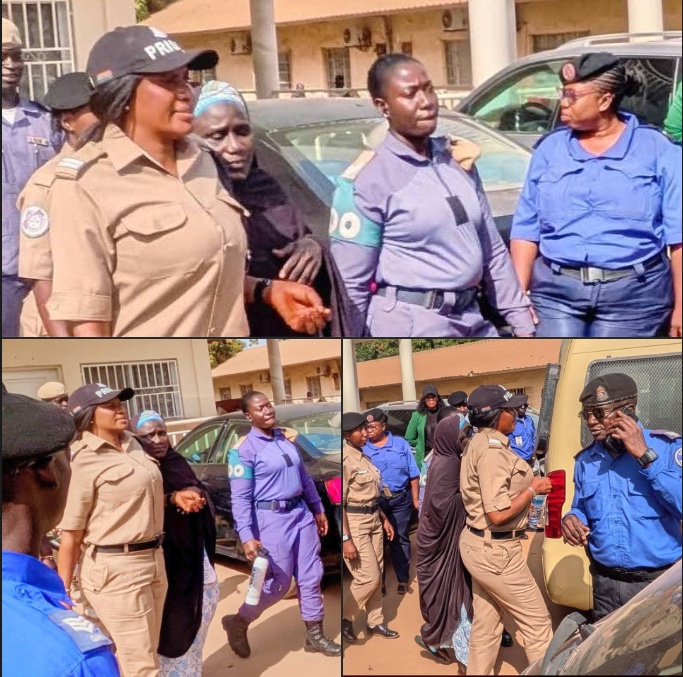
The trial of three women accused of performing female genital mutilation (FGM) resulting in the death of a one-year-old child continued on Thursday before Justice I. Janneh, with testimony from a medical doctor of Bundung Maternity Hospital.
The accused—Fatou Camara, Hawa Conteh, and Oumie Sawaneh—are alleged by the state to have circumcised the infant, leading to her death from complications.
When the matter was called, State Counsel W.S. Madu appeared for the prosecution. Counsel L.S. Camara represented the first accused, while Counsel J. Jeng appeared for the second and third accused.
State Counsel Madu informed the court that the prosecution had filed and served defence counsel with a notice of an additional witness statement. Counsel Camara acknowledged receipt but noted that the prosecution had cited the defunct Criminal Procedure Code instead of the Criminal Offences Act 2025. He indicated that the defence had no objection to a textual amendment.
The court granted the prosecution’s request to amend the citation, as there were no objections.
Following the amendment, the prosecution called Dr. Stephanie Awa Mendy to testify. After taking the oath, Dr. Mendy introduced herself as a gynecologist and Deputy Head of the Department of Surgery at Bundung Maternity Hospital. She told the court that she holds a Bachelor of Medicine and Surgery from the University of The Gambia (2009) and is responsible for supervising the department, conducting ward rounds, attending vaginal deliveries, and performing surgeries.
Asked why she was in court, Dr. Mendy said she was testifying in relation to the death of a one-year-old child.
“The baby was brought dead into the facility due to hemorrhagic shock through female circumcision,” she told the court.
She explained that clinical history obtained from the family revealed the child had been circumcised two days earlier and had been bleeding continuously. According to her testimony, the father instructed the mother to take the baby to the hospital, but by the time they arrived, the child was no longer breathing.
“A physical examination confirmed excessive bleeding in the vaginal area,” Dr. Mendy said, adding that the circumcision and subsequent blood loss caused the child’s death.
Dr. Mendy further testified that the initial assessment was conducted by Dr. Irma Font, who later discussed the case during the hospital’s routine morning meeting. She said the information was documented in hospital records by Dr. Font, who is currently in Cuba. She noted that taking clinical history and making diagnoses based on such information is standard medical practice.
When asked whether she could identify the report, Dr. Mendy said she could recognize it by the hospital form. However, upon being shown a document, she stated it was a police report rather than a hospital record. She explained that police often prepare their own reports in such cases, which are separate from hospital documentation.
State Counsel Madu subsequently substituted the police report with the hospital report and applied to tender it into evidence under Section 3 of the Evidence Act.
Counsel L.S. Camara objected, arguing that the application failed to meet the requirements of Section 40 of the Evidence Act. He submitted that Dr. Mendy was neither the author of the report nor authorised by the Head of Department to present it, and had not confirmed whether it bore Dr. Font’s signature. He urged the court to reject the document.
As Counsel F.K. Darboe rose to object on behalf of the second and third accused, the first accused, Fatou Camara, suddenly collapsed in the dock. Court security intervened to prevent her from falling, prompting Justice Janneh to briefly stand down proceedings.
When the court resumed, Counsel Darboe also objected to the admission of the report, arguing that no proper foundation had been laid. He submitted that Dr. Mendy had no personal knowledge of the examination, which was conducted by Dr. Font, and that the witness could not be cross-examined on a document she did not prepare.
In response, State Counsel Madu argued that Dr. Mendy had already testified on the cause of death and would reasonably be familiar with her colleague’s handwriting. He maintained that the document was relevant under Section 3 of the Evidence Act and urged the court to admit it.
Counsel Camara and Counsel Darboe countered that relevance alone does not determine admissibility and that Section 3 does not override other statutory provisions, including Section 40.
Justice I. Janneh adjourned the matter to February 10, 2026, for a ruling on the admissibility of the hospital report.
Comments are closed.