


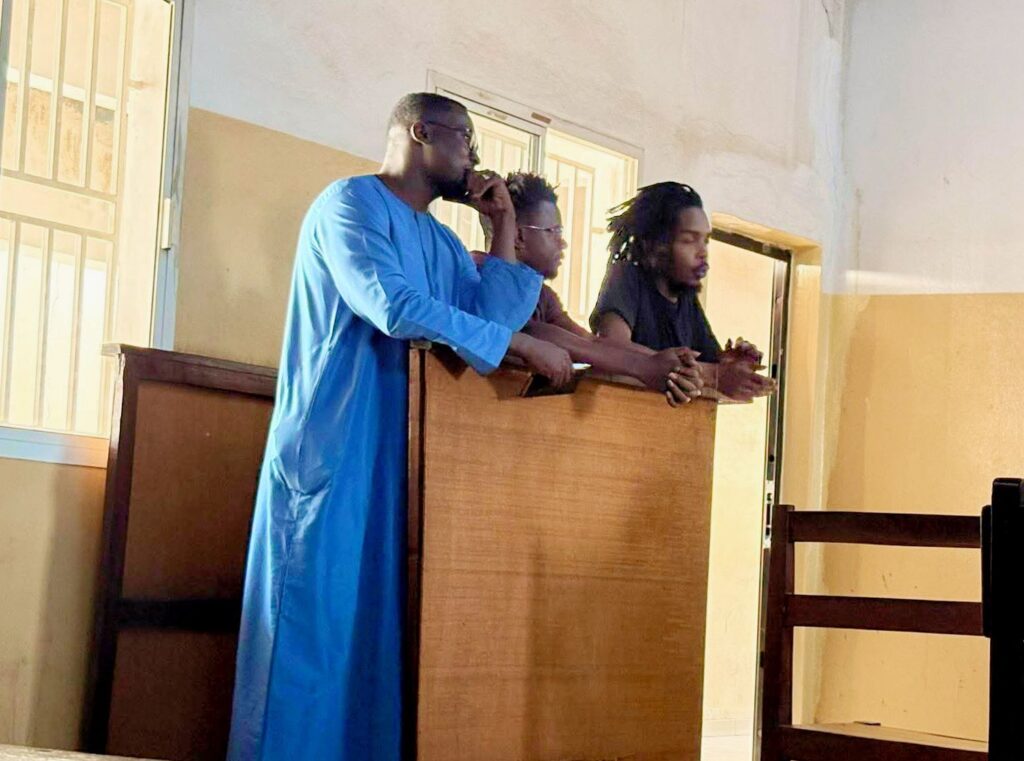
Photo Credit: Kexx
Prosecutors on Monday closed their case against members of Gambians Against Looted Assets, bringing the trial closer to a conclusion after a tense exchange over whether one of the accused should be arrested for failing to appear in court.
The proceedings at the Kanifing Magistrates’ Court were briefly disrupted when Commissioner Sanneh, appearing for the inspector general of police, noted that Omar Saibou Camara was absent as the case was called. Two co-defendants, Alieu Bah and Kemo Fatty, were present.
Citing Camara’s second failure to appear, Commissioner Sanneh applied for a bench warrant.
“We are applying for a bench warrant to be issued for Omar Camara’s arrest and detention,” he told the court, arguing that the absence threatened the integrity of the proceedings.
Defense counsel, L.S. Camara, immediately sought the court’s indulgence, saying he had been informed that his client was on his way. He urged the magistrate to allow the hearing to proceed rather than impose punitive measures.
“I cannot lie to this court; I do not know exactly why he is not here on time as I expected,” Mr. Camara said. He asked that the case continue in his client’s absence for the moment, noting that the charge was a misdemeanor and proposing that the court revisit the warrant only if Camara failed to appear by the end of the day.
The presiding magistrate, Sallah Mbye, agreed, allowing the prosecution to proceed while reserving a ruling on the warrant.
The state then called its fourth and final witness, Sub-Inspector Ousman Colley of the Kairaba Police Station’s criminal investigations unit. Mr. Colley testified that he had been part of an investigative panel assigned to interview the three activists following a Sept. 15 incident in which they were alleged to have attempted to stage a protest at the National Audit Office.
Mr. Colley told the court that the group had been ordered to disperse by senior police officers and later by a Police Intervention Unit team, but refused. He said the refusal led to their arrest and charges for protesting without a permit.
Under cross-examination, however, the defense established that Mr. Colley had not been present at the scene and was relying entirely on information provided by others. He acknowledged that he did not witness the arrests, did not know who carried them out, and could not say precisely where each defendant was detained.
As the questioning ended, Mr. Camara, the absent defendant, entered the courtroom and took his place in the dock, rendering the warrant application moot.
Commissioner Sanneh then attempted to re-examine the witness, asking whether the defendants had produced a permit during questioning. Defense counsel objected sharply, arguing that re-examination is limited to clarifying matters raised in cross-examination and cannot be used to introduce new evidence.
Citing provisions of the Evidence Act, Mr. Camara said the prosecution was improperly trying to reopen its case. Commissioner Sanneh countered that the question was necessary to clarify doubt surrounding the permit issue.
Magistrate Mbye sided with the defense, ruling that the witness had not given contradictory testimony and that the prosecution’s question fell outside the scope of permissible re-examination.
With the objection upheld, Commissioner Sanneh formally closed the prosecution’s case.
The matter was adjourned to March 9, 2026, at 9:30 a.m., when the defense is expected to open its case. Mr. Camara told the court that his team intends to file a no-case-to-answer submission.
Comments are closed.