


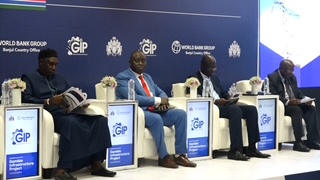
Officials at the launch
By Makutu Manneh
The Government of The Gambia and the World Bank on Tuesday launched a $52.6 million infrastructure program aimed at strengthening climate-resilient infrastructure, improving basic service delivery, and enhancing institutional capacity across key sectors of the economy.
The multi-year initiative, known as the Gambia Infrastructure Project (GIP), is expected to directly benefit more than 100,000 people through improved road connectivity and expanded access to electricity, supporting long-term and inclusive socio-economic development.
Speaking at the launch on behalf of the Minister of Finance and Economic Affairs, the Minister of Public Service, Baboucarr Boye, said the project aligns closely with the National Development Plan’s recovery and growth priorities and reflects the government’s commitment to inclusive development, climate resilience, and effective public service delivery.
Mr. Boye described the initiative as timely, noting that The Gambia’s economy continues to grow, driven by construction, agriculture, services, and infrastructure investment. “The demand for reliable transport networks and stable energy systems has never been greater,” he said.
He expressed the government’s appreciation for its partnership with the World Bank, which he said has consistently supported national priorities in infrastructure, governance, social protection, and climate resilience. The GIP, he added, further deepens that collaboration and demonstrates a shared commitment to delivering measurable benefits to Gambians.
“I wish to reaffirm the government’s strong ownership of this project and our commitment to ensuring that it is implemented with transparency, accountability, and a clear focus on results,” Mr. Boye said.
The World Bank’s Resident Representative in The Gambia, Franklin Mutahakana, described the project as a significant milestone, marking the institution’s renewed engagement in the country, particularly in the transport sector. He said this is an opportunity to build on the achievements of the GERMP to boost the Gambians participation in the M300 initiative, adding that Gambia has already signed the cohort and it is in its the second cohort.
Mr. Mutahakana noted that the project incorporates innovative elements, including the development of an active mobility corridor, solar-powered street lighting, and a credit enhancement mechanism.
“The project includes innovative approaches such as the development of an active mobility corridor, solar-equipped street lighting, and a credit enhancement mechanism,” he said.
The Minister of Petroleum, Energy, and Mines, Nani Juwara, said the project would help address long-standing challenges in electricity transmission and distribution while expanding access to reliable power, particularly for communities at the last mile of the national grid.
He said the initiative would support the extension and densification of electricity networks in rural areas, including the construction of approximately 142 kilometers of medium-voltage lines, 350 kilometers of low-voltage lines, and 92 medium- to low-voltage substations.
“The project will support the extension and densification of electricity networks in rural communities. This will involve the construction of approximately 142 kilometers of medium-voltage lines, 350 kilometers of low-voltage lines, and 92 medium- to low-voltage substations,” Mr. Juwara added.
Ebrima Sillah, the Minister of Transport, Works, and Infrastructure, described the project’s core components as central to any credible national development agenda. He said the investments are fully aligned with the National Development Plan and have the government’s full backing.
Such support, he added, carries a responsibility to manage public resources prudently, uphold transparency and accountability, and ensure value for money.
“Together we will fully support the central coordination unit of the Ministry of Finance and Economic Affairs to fast-track delivery and ensure that these investments translate into real, tangible benefits for Gambians,” he said.
The Gambia Infrastructure Project is financed by the International Development Association (IDA), the World Bank’s concessional lending arm. Implementing agencies include the Ministry of Transport, Works and Infrastructure; the Ministry of Petroleum and Energy; the National Roads Authority; the National Water and Electricity Company (NAWEC); the Public Utilities Regulatory Authority (PURA); and the Ministry of Finance and Economic Affairs through its Central Project Coordination Unit.